Product details
- Publisher : Springer; 2001st edition (November 30, 2001)
- Language : English
- Hardcover : 444 pages
- ISBN-10 : 1402001231
- ISBN-13 : 978-1402001239
- Item Weight : 4.01 pounds
- Dimensions : 6.14 x 1 x 9.21 inches
$215.28
2001st Edition
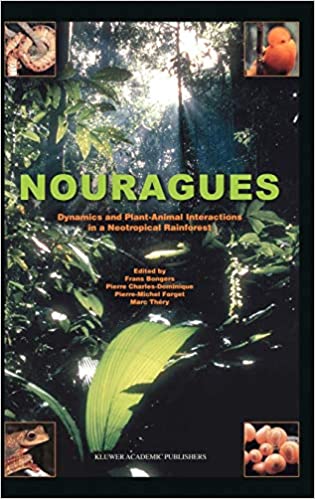
by F. Bongers (Editor), P. Charles-Dominique (Editor), P.-M. Forget (Editor), Marc Théry (Editor)
Nouragues is a tropical forest research station in French Guiana. It was established in 1986 for research on natural mechanisms of forest regeneration. Since then a lot of research has been done on this and related topics.
This book provides an overview of the main research results, and focuses on plant communities, vertebrate communities and evolutionary ecology, frugivory and seed dispersal, and forest dynamics and recruitment.
The appendices give (annoted) checklists of plants, birds, mammals, herpetofauna and fishes found in the same area.
Shipping rates are calculated based on local US cities; international rates may apply for other countries.
Illustrated Edition
1st Edition
by R. Toby Pennington (Editor), James A. Ratter (Editor)
More often than not, when people think of a neotropical forest, what comes to mind is a rain forest, rather than a dry forest. Just as typically, when they imagine a savanna, they visualize the African plains, rather than those dry woodlands and grasslands found in the Neotropics. These same preconceptions can be found among scientists, as these neotropical biomes receive nowhere near the attention they should - in terms of both research and conservation -considering the amount of land they encompass and the diversity of vegetation they contain. Neotropical Savannas and Dry Forests: Plant Diversity, Biogeography, and Conservation provides an engaging synthesis of information on the plant diversity and geography, as well as the conservation status, of these species-rich areas. This impressive compilation is the result of a plant diversity symposium that took place during an international conference on tropical savannas and seasonally dry forests held in 2003. Fifty leading scientists, representing a variety of disciplines have contributed to the chapters of this book in an effort to address three questions:
2005th Edition
by Florencia Montagnini (Author), Carl F. Jordan (Author)
1st ed. 2020 Edition
2009th Edition
by Mark Cochrane (Author)
The tropics are home to most of the world’s biodiversity and are currently the frontier for human settlement. Tropical ecosystems are being converted to agricultural and other land uses at unprecedented rates. Land conversion and maintenance almost always rely on fire and, because of this, fire is now more prevalent in the tropics than anywhere else on Earth. Despite pervasive fire, human settlement and threatened biodiversity, there is little comprehensive information available on fire and its effects in tropical ecosystems. Tropical deforestation, especially in rainforests, has been widely documented for many years. Forests are cut down and allowed to dry before being burned to remove biomass and release nutrients to grow crops. However, fires do not always stop at the borders of cleared forests. Tremendously damaging fires are increasingly spreading into forests that were never evolutionarily prepared for wild fires. The largest fires on the planet in recent decades have occurred in tropical forests and burned millions of hectares in several countries. The numerous ecosystems of the tropics have differing levels of fire resistance, resilience or dependence. At present, there is little appreciation of the seriousness of the wild fire situation in tropical rainforests but there is even less understanding of the role that fire plays in the ecology of many fire adapted tropical ecosystems, such as savannas, grasslands and other forest types.Unknown Binding – January 1, 1999
by Daniel C Nepstad (Author)


There are no reviews yet.