Product details
- Publisher : MDPI AG (July 19, 2018)
- Language : English
- Paperback : 340 pages
- ISBN-10 : 3038970999
- ISBN-13 : 978-3038970996
- Item Weight : 1.61 pounds
- Dimensions : 6.69 x 0.92 x 9.61 inches
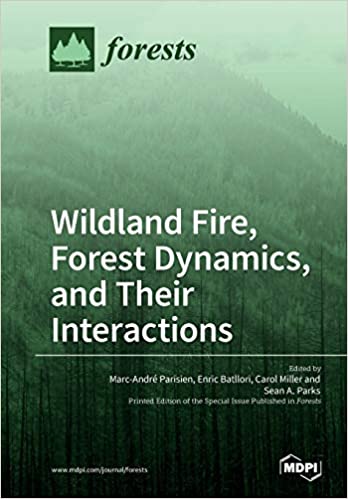
$81.00
by Marc-André Parisien (Editor), Enric Batllori (Editor), Sean A. Parks Carol Miller (Editor)
Wildland fire is an important, pervasive, and a sometimes-destructive ecological process in many forest ecosystems across the globe. In some cases, wildland fire maintains and reinforces forest dynamics. This is common, for example, in forests with thick-barked species that are adapted to frequent, low-severity fires or in forests where species’ regenerative traits (e.g., serotiny, resprouting) allow them to endure regimes of recurrent high-severity fire. However, wildland fire can also act as a catalyst that changes the successional trajectory of forest ecosystems, particularly if the factors responsible for historical fire regimes (e.g., frequency, severity, or season) have been substantially altered and exceed species’ adaptive capacity. Examples of these situations include effects of extreme fire weather and drought, fuel buildup due to fire exclusion or insect-induced mortality, and interactions between these factors. Some of these situations may result in fire-induced conversions from forest to non-forest ecosystems.
Shipping rates are calculated based on local US cities; international rates may apply for other countries.
2015th Edition
by Robert E. Keane (Author) A new era in wildland fuel sciences is now evolving in such a way that fire scientists and managers need a comprehensive understanding of fuels ecology and science to fully understand fire effects and behavior on diverse ecosystem and landscape characteristics. This is a reference book on wildland fuel science; a book that describes fuels and their application in land management. There has never been a comprehensive book on wildland fuels; most wildland fuel information was put into wildland fire science and management books as separate chapters and sections. This book is the first to highlight wildland fuels and treat them as a natural resource rather than a fire behavior input. Moreover, there has never been a comprehensive description of fuels and their ecology, measurement, and description under one reference; most wildland fuel information is scattered across diverse and unrelated venues from combustion science to fire ecology to carbon dynamics. The literature and data for wildland fuel science has never been synthesized into one reference; most studies were done for diverse and unique objectives. This book is the first to link the disparate fields of ecology, wildland fire, and carbon to describe fuel science. This just deals with the science and ecology of wildland fuels, not fuels management. However, since expensive fuel treatments are being planned in fire dominated landscapes across the world to minimize fire damage to people, property and ecosystems, it is incredibly important that people understand wildland fuels to develop more effective fuel management activities.1st Edition
by Edward A. Johnson (Editor), Kiyoko Miyanishi (Series Editor) Even before the myth of Prometheus, fire played a crucial ecological role around the world. Numerous plant communities depend on fire to generate species diversity in both time and space. Without fire such ecosystems would become sterile monocultures. Recent efforts to prohibit fire in fire dependent communities have contributed to more intense and more damaging fires. For these reasons, foresters, ecologists, land managers, geographers, and environmental scientists are interested in the behavior and ecological effects of fires. This book will be the first to focus on the chemistry and physics of fire as it relates to the ways in which fire behaves and the impacts it has on ecosystem function. Leading international contributors have been recruited by the editors to prepare a didactic text/reference that will appeal to both advanced students and practicing professionals.Hardcover – August 8, 2019
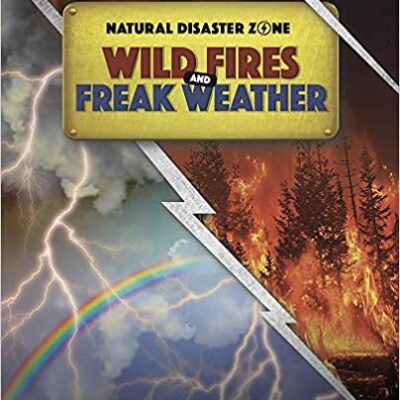
by Ben Hubbard (Author) Look inside natural disasters and discover how they work!Natural disasters devastate communities. They reshape the landscape and can alter people's ways of life in an area for years after the event. Learn all about wildfires and freak weather. Find out how they form, where they are mostly to happen and how scientists study them through diagrams and case studies.Explore how natural disasters work by cracking them open and looking at them from the inside. How do they happen How are they destructive What happens on the inside of each phenomena And where in the world are the danger zones This series explore each of these questions in detail.This series uses detailed artwork, cutaways and images from real-life to give a rounded view of each event. Perfect for readers aged 9 and up.2011th Edition
by Sara McAllister (Author), Jyh-Yuan Chen (Author), A. Carlos Fernandez-Pello (Author) Fundamentals of Combustion Processes is designed as a textbook for an upper-division undergraduate and graduate level combustion course in mechanical engineering. The authors focus on the fundamental theory of combustion and provide a simplified discussion of basic combustion parameters and processes such as thermodynamics, chemical kinetics, ignition, diffusion and pre-mixed flames. The text includes exploration of applications, example exercises, suggested homework problems and videos of laboratory demonstrationsHardcover – May 1, 2010
by G. Perona (Author) This book contains peer-reviewed papers presented at the Second International Conference on Modelling, Monitoring and Management of Forest Fires. Organized by the Wessex Institute of Technology, UK, in collaboration with the Politecnico di Torino, Italy, the conference was.held in Kos, Greece, in June, 2010. The papers cover important topics in the field of prevention and fighting of forest fires.Forest fire scenarios are impacted by climatic trends and changes in climatic extremes, as well as by human pressure on the natural environment. Forecasting the effects of both climatic and anthropic factors and separating their effects on forest fire frequency may be particularly difficult, but it is essential to improve our knowledge of the probability of forest fire occurrence and to better organize prevention and fighting activities. Considering the many fire-prone environments around the world and the meteorological parameters known to affect fire risk, the ability to estimate the probability of fire will be increasingly important in coming years. The papers from the conference will contribute to greater understanding of all these factors, so that we can prevent, monitor, and better manage forest fires(2007-02-28) Hardcover – January 1, 1885



There are no reviews yet.