Product details
- Publisher : VDM Verlag Dr. Müller (October 28, 2008)
- Language : English
- Paperback : 264 pages
- ISBN-10 : 3639083512
- ISBN-13 : 978-3639083514
- Item Weight : 12.6 ounces
- Dimensions : 5.91 x 0.6 x 8.66 inches
$107.72
by Eunmo Koo (Author)
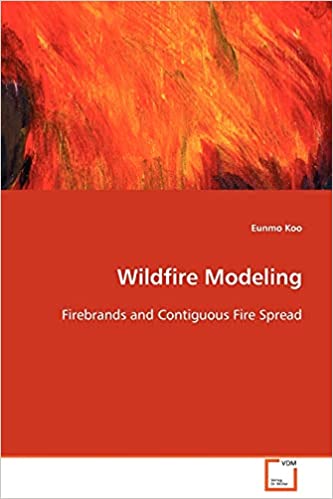
Wildfires are complex phenomenon. To understand their spread mechanisms, physics based wildfire models are developed here. Discontinuous fire spread, i.e., spotting, is studied through a review of historical wind-driven and post-earthquake fires. Transport of various shapes of combusting firebrands is modeled using momentum balance on the firebrand. Firebrand trajectories are simulated in velocity and thermal fields generated by the FIRETEC wildfire model. Contiguous fire spread is modeled based on energy conservation and detailed heat transfer mechanisms. Predictions of contiguous fire spread rates are compared to laboratory experiments and prescribed fires.
Shipping rates are calculated based on local US cities; international rates may apply for other countries.
1st Edition
by Edward A. Johnson (Editor), Kiyoko Miyanishi (Series Editor) Even before the myth of Prometheus, fire played a crucial ecological role around the world. Numerous plant communities depend on fire to generate species diversity in both time and space. Without fire such ecosystems would become sterile monocultures. Recent efforts to prohibit fire in fire dependent communities have contributed to more intense and more damaging fires. For these reasons, foresters, ecologists, land managers, geographers, and environmental scientists are interested in the behavior and ecological effects of fires. This book will be the first to focus on the chemistry and physics of fire as it relates to the ways in which fire behaves and the impacts it has on ecosystem function. Leading international contributors have been recruited by the editors to prepare a didactic text/reference that will appeal to both advanced students and practicing professionals.by Vladimir Ya. Alexandrov (Author), V.A. Bernstam (Translator)
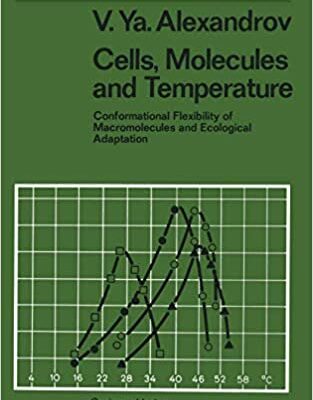
(Ecological Studies, 21) Softcover reprint of the original 1st ed. 1977 EditionAfter the great achievements in the field of molecular foundations of genetics and protein synthesis, molecular biology undertook the successful deciphering of a number of other important biological problems. By this time ecology in its various branches was far enough advanced to tackle the problems arising at the level of molecular biology. The monograph of Professor Alexandrov, which takes as an example the adaptation of organisms to habitat temperatures, presents a vivid picture of this major ecological problem as viewed at the cellular and molecular levels. As main theme of the book the author advances a hypothesis on a correlation between the level of conformational flexibility of protein molecules and the temperature ecology of a species, as a result of which the protein molecules are maintained in a semilabile state. This principle may also be applied to other factors of the environment which affect the level of flexibility of protein macro molecules. The principle of semistability is shown to be applicable also to the nucleic and fatty acids.
5th Edition
by Irvin Glassman (Author), Richard A. Yetter (Author), Nick G. Glumac (Author) Throughout its previous four editions, Combustion has made a very complex subject both enjoyable and understandable to its student readers and a pleasure for instructors to teach. With its clearly articulated physical and chemical processes of flame combustion and smooth, logical transitions to engineering applications, this new edition continues that tradition. Greatly expanded end-of-chapter problem sets and new areas of combustion engineering applications make it even easier for students to grasp the significance of combustion to a wide range of engineering practice, from transportation to energy generation to environmental impacts. Combustion engineering is the study of rapid energy and mass transfer usually through the common physical phenomena of flame oxidation. It covers the physics and chemistry of this process and the engineering applications―including power generation in internal combustion automobile engines and gas turbine engines. Renewed concerns about energy efficiency and fuel costs, along with continued concerns over toxic and particulate emissions, make this a crucial area of engineeringHardcover – May 1, 2010
by G. Perona (Author) This book contains peer-reviewed papers presented at the Second International Conference on Modelling, Monitoring and Management of Forest Fires. Organized by the Wessex Institute of Technology, UK, in collaboration with the Politecnico di Torino, Italy, the conference was.held in Kos, Greece, in June, 2010. The papers cover important topics in the field of prevention and fighting of forest fires.Forest fire scenarios are impacted by climatic trends and changes in climatic extremes, as well as by human pressure on the natural environment. Forecasting the effects of both climatic and anthropic factors and separating their effects on forest fire frequency may be particularly difficult, but it is essential to improve our knowledge of the probability of forest fire occurrence and to better organize prevention and fighting activities. Considering the many fire-prone environments around the world and the meteorological parameters known to affect fire risk, the ability to estimate the probability of fire will be increasingly important in coming years. The papers from the conference will contribute to greater understanding of all these factors, so that we can prevent, monitor, and better manage forest fires2nd Edition
by James G. Quintiere (Author)
This text covers the four forms of fire: diffusion flames, smoldering, spontaneous combustion, and premixed flames. Using a quantitative approach, the text introduces the scientific principles of fire behavior, with coverage of heat transfer, ignition, flame spread, fire plumes, and heat flux as a damage variable. Cases, examples, problems, selected color illustrations and review of mathematics help students in fire safety and investigation understand fire from a scientific point of view.


There are no reviews yet.