Product details
-
-
- Publisher : Elsevier; 1st edition (October 27, 2014)
- Language : English
- Hardcover : 284 pages
- ISBN-10 : 0124104347
- ISBN-13 : 978-0124104341
- Item Weight : 1.26 pounds
- Dimensions : 6.1 x 0.7 x 9.1 inches
-
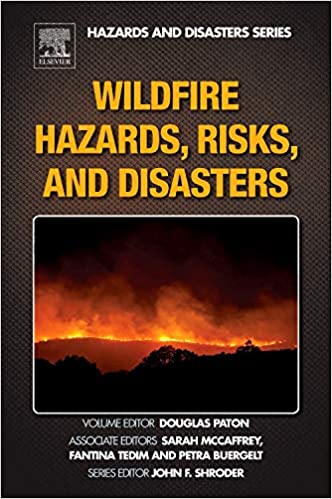
$129.95
1st Edition
by John F. Shroder (Editor), Douglas Paton (Editor)
More than 90% of wildfires are caused by human activity, but other causes include lighting, drought, wind and changing weather conditions, underground coal fires, and even volcanic activity. Wildfire Hazards, Risks, and Disasters, one of nine volumes in the Elsevier Hazards and Disasters series, provides a close and detailed examination of wildfires and measures for more thorough and accurate monitoring, prediction, preparedness, and prevention. It takes a geo-scientific and environmental approach to the topic while also discussing the impacts of human-induced causes such as deforestation, debris burning and arson―underscoring the multi-disciplinary nature of the topic. It presents several international case studies that discuss the historical, social, cultural and ecological aspects of wildfire risk management in countries with a long history of dealing with this hazard (e.g., USA, Australia) and in countries (e.g., Taiwan) where wildfire hazards represent a new and growing threat to the social and ecological landscape.
Shipping rates are calculated based on local US cities; international rates may apply for other countries.
Kindle Edition
by David Chorlton (Author), Julie Comnick (Illustrator) Format: Kindle Edition
The Flagstaff Arts Council selected 10 artists and a poet to contribute to an exhibition addressing the role of fire in forest management. In September of 2014 the group visited the North Rim of the Grand Canyon where numerous fire managers, ecologists, and fighters, spoke about the past, present, and potential futures of fire on the Colorado Plateau. David Chorlton was the poet, and A Field Guide to Fire is the collection of poems he wrote. The book also contains charcoal drawings by Julie Comnick, one of the artists. The poems draw on historic as well as contemporary sources to reflect on differing cultural attitudes toward the use of fire in forests, and they address ecology in the age of climate change. The exhibition, Fires of Change, was conceived as a collaboration between science and art. A Field Guide to Fire is a lyrical response, beautifully balanced by visual art.
Paperback – October 12, 2013
by National Wildfire Coordinating Group (Author)
The objectives of this guide are to: Define and standardize national interagency operating procedures at large airtanker bases to ensure safe and efficient operations; Support fire policy through interagency coordination; Facilitate the exchange of personnel from all wildland fire suppression agencies during periods of high fire activity through standardization; Provide a common, interagency approach in the State, Federal, and Tribal Government’s contract related responsibilities; Provide common forms, checklists, orientations outlines, and special instructions for both contractor employees (retardant supplier personnel, pilots, mechanics) and government employees at airtanker bases; Provide a framework, which allows each airtanker base to provide a local base supplement with site specific guidance.
2009th Edition
by F Stuart Chapin III(Editor), Gary P. Kofinas(Editor), Carl Folke(Editor), M.C. Chapin(Illustrator)
The world is undergoing unprecedented changes in many of the factors that determine its fundamental properties and their in- ence on society. These changes include climate; the chemical c- position of the atmosphere; the demands of a growing human population for food and ?ber; and the mobility of organisms, ind- trial products, cultural perspectives, and information ?ows. The magnitude and widespread nature of these changes pose serious challenges in managing the ecosystem services on which society depends. Moreover, many of these changes are strongly in?uenced by human activities, so future patterns of change will continue to be in?uenced by society’s choices and governance. The purpose of this book is to provide a new framework for n- ural resource management―a framework based on stewardship of ecosystems for human well-being in a world dominated by unc- tainty and change. The goal of ecosystem stewardship is to respond to and shape change in social-ecological systems in order to s- tain the supply and opportunities for use of ecosystem services by society. The book links recent advances in the theory of resilience, sustainability, and vulnerability with practical issues of ecosystem management and governance. The book is aimed at advanced undergraduates and beginning graduate students of natural resource management as well as professional managers, community leaders, and policy makers with backgrounds in a wide array of d- ciplines, including ecology, policy studies, economics, sociology, and anthropology
by António José Bento Gonçalves(Editor), António Avelino Batista Vieira(Editor), Maria Rosário Melo Costa(Editor), José Tadeu Marques Aranha(Editor)
The present book intends to outline different approaches regarding wildland fires, showing different perspectives and challenges present in the beginning of the 21st century and emerging in different case studies that reveal how wildfires are being faced in some countries around the world (Portugal, Spain, Brazil, Algeria, Mozambique, Lithuania and Chile). Therefore, this book includes fifteen valuable contributions that reflect its title: Wildfires: Perspectives, Issues and Challenges of the 21st Century. The first part of this book includes topics that expresses different realities and challenges on wildfire analysis in Europe, South America and Africa, in a total of six chapters. The second part of this book, entitled “New Perspectives and Methodologies on Wildfire Research”, which is composed of five chapters, is focused on the implementation of recent techniques and methodologies to promote wildfire knowledge and forest management. The last part is related to recent developments on soils and ashes analysis, and their off-site effects on water quality. It is composed of four chapters where these topics are discussed.
1st Edition
Unknown Binding – January 1, 1993
by Doug Campbell (Author)


There are no reviews yet.