Product details
- Publisher : Routledge; 2nd edition (December 16, 2020)
- Language : English
- Hardcover : 1176 pages
- ISBN-10 : 1138581356
- ISBN-13 : 978-1138581357
- Item Weight : 1 pounds
- Dimensions : 6.85 x 9.69 inches

$227.67
2nd Edition
by Ian Douglas (Editor), P M L Anderson (Editor), David Goode (Editor), Michael C. Houck (Editor), David Maddox (Editor), Harini Nagendra (Editor), Puay Yok Tan (Editor)
This second edition covers recent developments around the world with contributors from 33 different countries. It widens the handbook’s scope by including ecological design; consideration of cultural dimensions of the use and conservation of urban nature; the roles of government and civil society; and the continuing issues of equity and fairness in access to urban greenspaces.
New features include an emphasis on the biophilic design of homes and workplaces, demonstrating the value of nature, in order to counter the still prevalent attitude among many developers that nature is a constraint rather than a value. The volume explores great practical achievements that have occurred since the first edition, with many governments increasingly recognizing and legislating on urban nature and green infrastructure matters, since cities play a major role in adapting to change, particularly to climate crisis. New topics such as the ecological role of light at night and human microbiota in the urban ecosystem are introduced. Additional attention is given to food production in cities, particularly the multiple roles of urban agriculture and household gardens in different contexts from wealthy communities to the poorest informal settlements in deprived communities. The emphasis is on demonstrating what can be achieved, and what is already being done.
The book aims to help scholars and graduate students by providing an invaluable and up-to-date guide to current urban ecological thinking across the range of disciplines, such as geography, ecology, environmental science/studies, planning, and urban studies, that converge in the study of towns and cities and urban design and living. It will also assist practitioners and civil society members in discovering the ways diff erent specialists and thinkers approach urban nature.
Shipping rates are calculated based on local US cities; international rates may apply for other countries.
Hardcover – August 17, 2021
by Lizzie Johnson (Author)
Pre-order Price Guarantee.Paperback – August 1, 2015
by Vic Jurskis (Author)
Aborigines came to Australia and burnt out most of the trees and bushes. The megafauna starved whilst eucalypts, herbs, grasses and mesofauna flourished. The ancient culture survived an ice age, global warming and hugely rising seas, forging economies in woodlands and deserts. Europeans doused the firestick, woodlands turned to scrub, mesofauna perished, megafires and tree-eaters irrupted. Foresters rekindled the firestick and greens stole it. Megafires and declines are back with a vengeance whilst ecologists dream-up reasons not to burn. Ecological history shows that we must apply the firestick frequently, willingly and skillfully to restore a healthy, safe environment and economy.Paperback – June 1, 2010
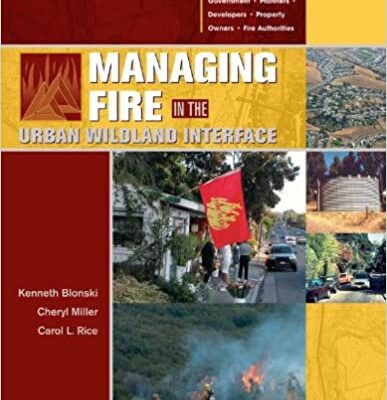
by Kenneth Blonski (Author), Cheryl Miller (Author), Carol L. Rice (Author)
A unique guide to solutions and strategies for managing fire at the urban edge. Offers analytical tools and comprehensive summaries not found in other manuals dealing with fire mitigation. Designed as a reference, Managing Fire in the Urban Wildland Interface provides information on codes and laws and includes case studies, tables, figures, suggested websites, and other source material. Draws on best practices from California, with lessons applicable nationwide.
Equally useful to state, federal and local agency staff and officials, fire agency staff, attorneys, architects, landscape architects, property owners, developers, insurance company managers, and business and community leaders. Topics include: Key federal, state, and local provisions for managing urban wildland interface fires; Completing a fire threat assessment and developing a plan; Implementing the best solutions for your community; Community awareness and ignition prevention; Design solutions for new and existing residential development, roads, utilities, structural design and materials, and landscaping; Emergency service response; Critical challenges, including environmental challenges, vested interests, human behavior, and funding; Managing Fire in the Urban Wildland Interface has been recognized by the major planning associations in California, as winner of the 2011 Education Award from the APA (American Planning Association)-California Northern Section and 2011 Outstanding Environmental Resource Document Award from the 2011 California Chapter of AEP (Association of Environmental Professionals).Hardcover – January 1, 2003
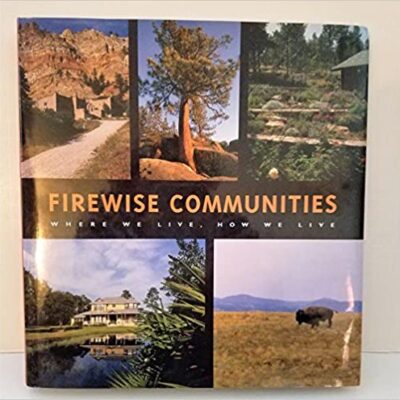
by J. Randall Ismay (Author)
Book about neighborhoods who work together to reduce their wildfire risks
1st ed. 2020 Edition
by Samuel L. Manzello (Editor)
This reference work encompasses the current, accepted state of the art in the science of wildfires and wildfires that spread to communities, known as wildland-urban interface (WUI) fires. 171 author contributions include accepted knowledge on these topics from throughout the world, all written by the leading researchers, experts, practitioners, and academics. This encyclopedia is an invaluable reference for newcomers to the field, as well as researchers, students, developers, and professionals who are interested in exploring this dynamic area. General Sections include: Combustion Coordination System Locations Fire Whirls Firebrands and Embers Incident Management Team (IMT) Support Locations Incident Response Support Locations On-the-Incident Locations Soot and Effects on Wildland/WUI Fire Behavior Weathering Effects on Fire Retardant Wood Treatments Wildland Firefighting Locations Wildland Fuel Treatments1935-1954 Hardcover – January 1, 1971
by Joseph L Arnold (Author)
"It is a rare surprise to find a doctoral dissertation that turns out this good. Arnold somehow manages to explain the significance of many of the New Deal's alphabet soup agencies while focusing his story on the main players' characters and motivations. Rexford Tugwell's insouciant megalomania are perfectly on display here, as is a nation's fascinated horror about his (the RA's), "Soviet Communes in America." FDR's interest in the program is traced back to his city planning uncle Frederick Delano, who would wax philosophic to a young FDR on the need for comprehensive regional plans. Even Dean Acheson makes an improbable appearance here as a land syndicate lawyer suing to stop a public housing program in the New Jersey countryside. But as is appropriate with a story about a social experiment, Arnold also examines the effects of the experiment on the test subjects. He finds that the early inhabitants of these new towns founded a variety of institutions that spontaneously mirrored many the New Dealers were trying to form from on high. There were credit and shopping cooperatives, non-profit hospitals, community newspapers. Most failed quickly, but a few survive to this day (Greenbelts co-op grocery is still there, check it out)." by Frank Stein


There are no reviews yet.