

Product details
- Publisher : Springer; 2001st edition (November 30, 2001)
- Language : English
- Hardcover : 444 pages
- ISBN-10 : 1402001231
- ISBN-13 : 978-1402001239
- Item Weight : 4.01 pounds
- Dimensions : 6.14 x 1 x 9.21 inches
$215.28
2001st Edition
by F. Bongers (Editor), P. Charles-Dominique (Editor), P.-M. Forget (Editor), Marc Théry (Editor)
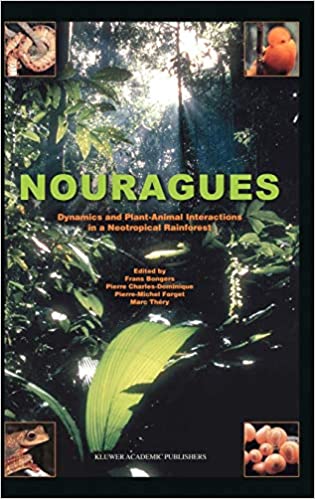
Nouragues is a tropical forest research station in French Guiana. It was established in 1986 for research on natural mechanisms of forest regeneration. Since then a lot of research has been done on this and related topics.
This book provides an overview of the main research results, and focuses on plant communities, vertebrate communities and evolutionary ecology, frugivory and seed dispersal, and forest dynamics and recruitment.
The appendices give (annoted) checklists of plants, birds, mammals, herpetofauna and fishes found in the same area.
Shipping rates are calculated based on local US cities; international rates may apply for other countries.
2011th Edition
by Wolfgang J. Junk (Editor), Maria T. F. Piedade (Editor), Florian Wittmann (Editor), Jochen Schöngart (Editor), Pia Parolin (Editor)
Central Amazonian floodplain forests are an unique and endangered ecosystem. The forests grow in areas that are annually flooded by large rivers during mean periods of up to 8 months and at depths of up to 10 m. Despite this severe stress, these forests consist of over 1,000 species and are by far the most species-rich floodplain forests worldwide. The trees show a broad range of morphological, anatomical, physiological, and phenological adaptations that enable them not only to survive the adverse environmental conditions, but also to produce large amounts of biomass when the nutrient levels in water and soils are sufficiently high. This is the case in the floodplains of white-water rivers, which are used for fisheries, agriculture, and cattle-ranching but which also have a high potential for the production of timber and non-timber products, when adequately managed. Latest research on ecophysiology gives insight how tree species adapt to the oscillating flood-pulse focusing on their photosynthesis, respiration, sap flow, biochemistry, phenology, wood and leave anatomy, root morphology and functioning, fruit chemistry, seed germination, seedling establishment, nitrogen fixation and genetic variability. Based on tree ages, lifetime growth rates and net primary production, new concepts are developed to improve the sustainability of traditional forest managements in the background of an integrated natural resource management. This is the first integrative book on the functioning and ecologically oriented use of floodplain forests in the tropics and sub-tropics.It provides fundamental knowledge for scientist, students, foresters and other professionals on their distribution, evolution and phytogeography. “This book is an excellent testimony to the interdisciplinary collaboration of a group of very dedicated scientists to unravel the functioning of the Amazonian Floodplain forests. They have brought together a highly valuable contribution on the distribution, ecology, primary production, ecophysiology, typology, biodiversity, and human use of these forests offering recommendations for sustainable management and future projects in science and development of these unique wetland ecosystems. It lays a solid scientific foundation for wetland ecologists, foresters, environmentalists, wetland managers, and all those interested in sustainable management in the tropics and subtropics.” Brij Gopal, Executive Vice President International Society for Limnology (SIL).
Kindle Edition
This Special Issue looks forward as well as backward to best analyze the forest conservation challenges of the Caribbean. This is made possible by 75 years of research and applications by the United States Department of Agriculture, International Institute of Tropical Forestry (the Institute) of Puerto Rico. It transforms Holocene-based scientific paradigms of the tropics into Anthropocene applications and outlooks of wilderness, managed forests, and urban environments. This volume showcases how the focus of the Institute's programs is evolving to support sustainable tropical forest conservation despite uncertain conditions. The manuscripts showcased here highlight the importance of shared stewardship and a long-term, hands-on approach to conservation, research programs, and novel organizations intended to meet contemporary conservation challenges. Policies relevant to the Anthropocene, as well as the use of experiments to anticipate future responses of tropical forests to global warming, are reexamined in these pages. Urban topics include how cities can co-produce new knowledge to spark sustainable and resilient transformations. Long-term results and research applications of topics such as soil biota, migratory birds, tropical vegetation, substrate chemistry, and the tropical carbon cycle are also described in the volume. Moreover, the question of how to best use land on a tropical island is addressed. This volume is intended to be of interest to all actors involved in long-term sustainable forest management and research in light of the historical lessons and future directions that may come out of a better understanding of tropical cities and forests in the Anthropocene epoch.
First Edition
by William Allen (Author), Samantha Burton (Illustrator)
Can we prevent the destruction of the world's tropical forests? In the fire-scarred hills of Costa Rica, award-winning science writer William Allen found a remarkable answer: we can not only prevent their destruction--we can bring them back to their former glory. In Green Phoenix, Allen tells the gripping story of a large group of Costa Rican and American scientists and volunteers who set out to save the tropical forests in the northwestern section of the country. It was an area badly damaged by the fires of ranchers and small farmers; in many places a few strands of forest strung across a charred landscape. Despite the widely held belief that tropical forests, once lost, are lost forever, the team led by the dynamic Daniel Janzen from the University of Pennsylvania moved relentlessly ahead, taking a broad array of political, ecological, and social steps necessary for restoration. They began with 39 square miles and, by 2000, they had stitched together and revived some 463 square miles of land and another 290 of marine area. Today this region is known as the Guanacaste Conservation Area, a fabulously rich landscape of dry forest, cloud forest, and rain forest that gives life to some 235,000 species of plants and animals. It may be the greatest environmental success of our time, a prime example of how extensive devastation can be halted and reversed. This is an inspiring story, and in recounting it, Allen writes with vivid power. He creates lasting images of pristine beaches and dense forest and captures the heroics and skill of the scientific teams, especially the larger-than-life personality of the maverick ecologist Daniel Janzen. It is a book everyone concerned about the environment will want to own.
1st Edition
by R. Toby Pennington (Editor), James A. Ratter (Editor)
More often than not, when people think of a neotropical forest, what comes to mind is a rain forest, rather than a dry forest. Just as typically, when they imagine a savanna, they visualize the African plains, rather than those dry woodlands and grasslands found in the Neotropics. These same preconceptions can be found among scientists, as these neotropical biomes receive nowhere near the attention they should - in terms of both research and conservation -considering the amount of land they encompass and the diversity of vegetation they contain. Neotropical Savannas and Dry Forests: Plant Diversity, Biogeography, and Conservation provides an engaging synthesis of information on the plant diversity and geography, as well as the conservation status, of these species-rich areas. This impressive compilation is the result of a plant diversity symposium that took place during an international conference on tropical savannas and seasonally dry forests held in 2003. Fifty leading scientists, representing a variety of disciplines have contributed to the chapters of this book in an effort to address three questions:
First Edition (US) First Printing
by Stephen H. Bullock (Editor), Harold A. Mooney (Editor), Ernesto Medina (Editor)
Prolonged seasonal drought affects most of the tropics, including vast areas presently or recently dominated by 'dry forests'. These forests have received scant attention, despite the fact that humans have used and changed them more than rain forests. This volume reviews the available information, often making contrasts with wetter forests. The world's dry forest heterogeneity of structure and function is shown regionally. In the neotropics, biogeographic patterns differ from those of wet forests, as does the spectrum of plant life-forms in terms of structure, physiology, phenology and reproduction. Biomass distribution, nutrient cycling, below-ground dynamics and nitrogen gas emission are also reviewed. Exploitation schemes are surveyed, and examples are given of non-timber product economies. It is hoped that this review will stimulate research leading to more conservative and productive management of dry forests.


There are no reviews yet.