Product details
- Publisher : Fire Protection Publications; 2nd edition (January 1, 2020)
- Language : English
- Paperback : 495 pages
- ISBN-10 : 0879397454
- ISBN-13 : 978-0879397456
- Item Weight : 3.05 pounds
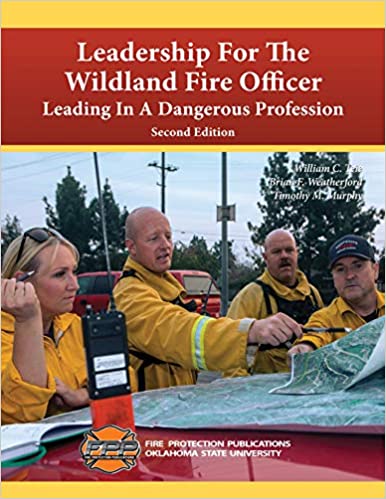
$81.01
Paperback – January 1, 2020
by William C. Teie(Author), Brian F. Weatherford(Author), Timothy M. Murphy(Author)
The 2nd Edition of Bill Teie’s Leadership for the Wildland Fire Officer – Leading in a Dangerous Profession has been developed to address various supervisory and leadership positions of wildland firefighting outlined by the National Wildfire Coordinators Group (NWCG). This book is aimed toward new and experienced wildland firefighters who serve in a leadership role within their organizations. Chapters 1-5 are an excellent tool for any current or future leader in fire service. Chapters 6-9 deal with the situational and tactical processes a wildland fire officer faces daily. Following Chapter 9 is an addendum containing 15 after-action reports of “Fires We Should Not Forget” as well as the lesson learned from each fire. Accompanying curriculum is available, containtin PowerPoint presentations with instructor’s notes as well as chapter tests to guide and gauge student learning and knowledge.
Shipping rates are calculated based on local US cities; international rates may apply for other countries.
Paperback – August 30, 1999
by Robert Burns(Author), Mike Schintz(Author)
Bears and bureaucrats, timber and telephone lines, poaching and predators, fires and families -- all these play a part in this fascinating and long-overdue study of Canadas National Park wardens. The Warden Service has been integral to Canadas National Parks from their earliest days. First established in Rocky Mountains Park (now Banff National Park) in 1909, the position of Fire and Game Guardian was the precursor of todays National Park Warden, whose duties now include resource management, law enforcement and public safety. Robert Burns traces the growth of the warden service from here, its formative years, and goes on to show how the role changed and developed according to the expanding park system, altered societal expectations, and technological change. Guardians of the Wild is a study of real people and their trials, triumphs and tragedies. This book creates a complete history where before there existed only sketchy accounts of single individuals and incidents. The need for such an account is undeniable; well-known historian Simon Evans describes this story as "one which deserves to be heard." Both a tribute to the enormous devotion to duty and dedicated labours of the park wardens, and a well-researched factual account of how our National Parks evolved, Guardians of the Wild is a singular study of the historical evolution of protection and management inside Canadas National Parks.
by António José Bento Gonçalves(Editor), António Avelino Batista Vieira(Editor), Maria Rosário Melo Costa(Editor), José Tadeu Marques Aranha(Editor)
The present book intends to outline different approaches regarding wildland fires, showing different perspectives and challenges present in the beginning of the 21st century and emerging in different case studies that reveal how wildfires are being faced in some countries around the world (Portugal, Spain, Brazil, Algeria, Mozambique, Lithuania and Chile). Therefore, this book includes fifteen valuable contributions that reflect its title: Wildfires: Perspectives, Issues and Challenges of the 21st Century. The first part of this book includes topics that expresses different realities and challenges on wildfire analysis in Europe, South America and Africa, in a total of six chapters. The second part of this book, entitled “New Perspectives and Methodologies on Wildfire Research”, which is composed of five chapters, is focused on the implementation of recent techniques and methodologies to promote wildfire knowledge and forest management. The last part is related to recent developments on soils and ashes analysis, and their off-site effects on water quality. It is composed of four chapters where these topics are discussed.
Paperback – January 1, 1796
Paperback – October 1, 2013
by War Department (Author)
The M2-2 flamethrower was an American portable backpack incendiary device that was used in World War II. It was the successor to the M1 and M1A1 flamethrowers and offered improved reliability and a more efficient ignition system than previous models. It had a "burn time" of around seven seconds and the flame was effective out to around thirty-three meters. In 1944, the M2-2 flamethrower was introduced into service. It was first used in combat in Guam and was thereafter employed in all Pacific campaigns. Flamethrowers proved highly effective in fighting against the Japanese, especially in routing defenders from caves, pillboxes and underground emplacements.The arrival of flamethrowing tanks, which offered personnel protection and more firepower, lessened the Army's interest in and tactical use of portable flamethrowers. The M2 was upgraded for use during the Korean War (M2A1-2) and Vietnam War (M2A1-7), and eventually replaced by the lightweight M9A1-7. However, these were shelved after 1978 when the Department of Defense unilaterally stopped using flamethrowers on the grounds that they are inhumane and have little combat value.Created in 1944, this field manual reveals a great deal about the M2-2’s design and capabilities. Intended as a training manual for those charged withoperation and maintenance, it details many aspects of its controls, tools andaccessories. Originally labeled restricted, this manual was declassified long ago and is here reprinted in book form. Care has been taken to preserve the integrity of the text.
Hardcover – December 31, 1979
by S. S. Ajayi (Author), Lambert Beverley Halstead (Author)
Hardcover – January 1, 1938
by Shirley Walter Allen (Author)




There are no reviews yet.