Product details
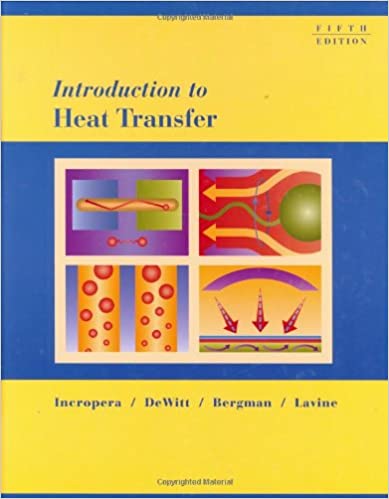
- Publisher : Wiley; 5th edition (April 7, 2006)
- Language : English
- Hardcover : 912 pages
- ISBN-10 : 0471457272
- ISBN-13 : 978-0471457275
- Item Weight : 3.6 pounds
- Dimensions : 8.33 x 1.31 x 10.16 inches
$80.76
5th Edition
by Frank P. Incropera (Author), David P. DeWitt (Author), Theodore L. Bergman (Author), Adrienne S. Lavine (Author)
Noted for its readability, comprehensiveness and relevancy, the new fifth edition of this bestselling book provides readers with an accessible examination of the heat transfer field. They’ll gain a better understanding of the terminology and physical principles for any process or system involving heat transfer. And they’ll find out how to develop representative models of real processes and systems, and draw conclusions concerning process/systems design or performance from the attendant analysis.
Shipping rates are calculated based on local US cities; international rates may apply for other countries.
by Vladimir Ya. Alexandrov (Author), V.A. Bernstam (Translator)
(Ecological Studies, 21) Softcover reprint of the original 1st ed. 1977 EditionAfter the great achievements in the field of molecular foundations of genetics and protein synthesis, molecular biology undertook the successful deciphering of a number of other important biological problems. By this time ecology in its various branches was far enough advanced to tackle the problems arising at the level of molecular biology. The monograph of Professor Alexandrov, which takes as an example the adaptation of organisms to habitat temperatures, presents a vivid picture of this major ecological problem as viewed at the cellular and molecular levels. As main theme of the book the author advances a hypothesis on a correlation between the level of conformational flexibility of protein molecules and the temperature ecology of a species, as a result of which the protein molecules are maintained in a semilabile state. This principle may also be applied to other factors of the environment which affect the level of flexibility of protein macro molecules. The principle of semistability is shown to be applicable also to the nucleic and fatty acids.
8th Edition, Kindle Edition
by Theodore L. Bergman (Author), Adrienne S. Lavine (Author), Frank P. Incropera (Author), & 1 more Format: Kindle Edition Fundamentals of Heat and Mass Transfer 8th Edition has been the gold standard of heat transfer pedagogy for many decades, with a commitment to continuous improvement by four authors’ with more than 150 years of combined experience in heat transfer education, research and practice. Applying the rigorous and systematic problem-solving methodology that this text pioneered an abundance of examples and problems reveal the richness and beauty of the discipline. This edition makes heat and mass transfer more approachable by giving additional emphasis to fundamental concepts, while highlighting the relevance of two of today’s most critical issues: energy and the environment.Hardcover – May 1, 2010
by G. Perona (Author) This book contains peer-reviewed papers presented at the Second International Conference on Modelling, Monitoring and Management of Forest Fires. Organized by the Wessex Institute of Technology, UK, in collaboration with the Politecnico di Torino, Italy, the conference was.held in Kos, Greece, in June, 2010. The papers cover important topics in the field of prevention and fighting of forest fires.Forest fire scenarios are impacted by climatic trends and changes in climatic extremes, as well as by human pressure on the natural environment. Forecasting the effects of both climatic and anthropic factors and separating their effects on forest fire frequency may be particularly difficult, but it is essential to improve our knowledge of the probability of forest fire occurrence and to better organize prevention and fighting activities. Considering the many fire-prone environments around the world and the meteorological parameters known to affect fire risk, the ability to estimate the probability of fire will be increasingly important in coming years. The papers from the conference will contribute to greater understanding of all these factors, so that we can prevent, monitor, and better manage forest fires2nd Edition
by James G. Quintiere (Author)
This text covers the four forms of fire: diffusion flames, smoldering, spontaneous combustion, and premixed flames. Using a quantitative approach, the text introduces the scientific principles of fire behavior, with coverage of heat transfer, ignition, flame spread, fire plumes, and heat flux as a damage variable. Cases, examples, problems, selected color illustrations and review of mathematics help students in fire safety and investigation understand fire from a scientific point of view.


There are no reviews yet.