
Product details
- Publisher : Routledge; 1st edition (June 28, 2017)
- Language : English
- ISBN-10 : 1138418684
- ISBN-13 : 978-1138418684
- Item Weight : 1 pounds
- Dimensions : 6.25 x 9.21 inches
$210.00
1st Edition
Shipping rates are calculated based on local US cities; international rates may apply for other countries.
1st ed. 2016 Edition
by Cathryn H. Greenberg (Editor), Beverly S. Collins (Editor)
This book discusses the historic range of variation (HRV) in the types, frequencies, severities and scales of natural disturbances, and explores how they create heterogeneous structure within upland hardwood forests of the Central Hardwood Region (CHR). The book was written in response to a 2012 forest planning rule which requires that national forests to be managed to sustain ‘ecological integrity’ and within the ‘natural range of variation’ of natural disturbances and vegetation structure. Synthesizing information on HRV of natural disturbance types, and their impacts on forest structure, has been identified as a top need.
1st Edition
by Lee E. Frelich (Author)
Lee Frelich provides a major contribution to the study of temperate-zone forest dynamics by considering three important themes: the combined influence of wind, fire, and herbivory on the successional trajectories and structural characteristics of forests; the interaction of deciduous and evergreen tree species to form mosiacs; and the significance of temporal and spatial scale with regard to the overall impact of disturbances. These themes are explored via case studies from the forests in the Lake States of Minnesota, Wisconsin and Michigan, where the presence of large primary forest remnants provides a unique opportunity to study the long-term dynamics of near-boreal, pine, and hardwood-hemlock forests.
Hardcover – May 29, 2015
Paperback – October 1, 2001
by George E. Gruell (Author)
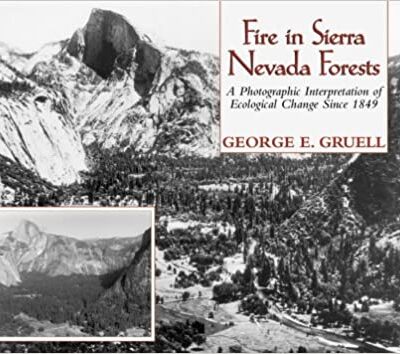
Fire in Sierra Nevada Forests examines the woodlands through repeat photography: rephotographing sites depicted in historical photographs to compare past vegetation to present.
Paperback â April 15, 2015
by Carl E. Fiedler (Author), Stephen F. Arno (Author)
The West�s vast ponderosa pine forest has been home to people for thousands of years. Ponderosa from distant mountains provided timbers for the ancient pueblos of the Southwest. Nomadic Native Americans often wintered among the large pines and peeled bark for food in spring. Pioneers on horseback extolled the giant pines and grassy glades of yesterday�s forest. Ponderosa timber was used to build Gold Rush-era flumes, sluice boxes, and mine shafts, as well as ties and trestles for the transcontinental railroad. That historic forest is mostly gone now, and a different forest has taken its place. Heavy early logging and successful fire suppression have transformed yesterday�s forest into a forest overgrown with smaller trees, shredded by bark beetles and ravaged by wildfires. But this new forest is at great risk, and that is the story of this book. Authors Carl E. Fiedler and Stephen F. Arno recount the history of humans among the ponderosa pines, the historical role of fire, how and why the forest has changed, and what people can do to restore the forest to its former glory. A richly illustrated guide at the back of the book features 64 ponderosa places scattered across the West, from dwarf pines growing in solid rock to towering trees in moist valleys.


There are no reviews yet.