
Product details
- Publisher : Edward Elgar Pub (November 9, 2009)
- Language : English
- Hardcover : 236 pages
- ISBN-10 : 1847209777
- ISBN-13 : 978-1847209771
- Item Weight : 1 pounds
- Dimensions : 6.25 x 0.5 x 9.25 inches
$102.42
by Colin A. G. Hunt (Author)
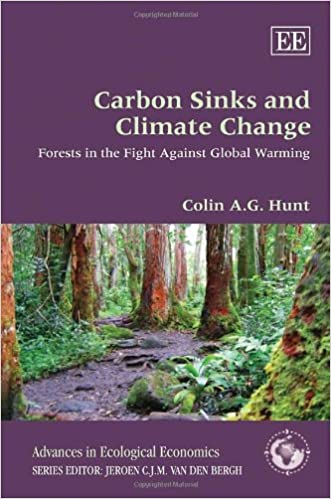
“Reforestation and avoiding deforestation are methods of harnessing nature to tackle global warming – the greatest challenge facing humankind. In this book, Colin Hunt deals comprehensively with the present and future role of forests in climate change policy and practice. The author provides signposts for the way ahead in climate change policy and offers practical examples of forestry’s role in climate change mitigation in both developed and tropical developing countries. Chapters on measuring carbon in plantations, their biodiversity benefits and potential for biofuel production complement the analysis. He also discusses the potential for forestry in climate change policy in the United States and other countries where policies to limit greenhouse gas emissions have been foreshadowed. The author employs scientific and socio-economic analysis and lays bare the complexity of forestry markets. A review of the workings of carbon markets, based both on the Kyoto Protocol and voluntary participation, provides a foundation from which to explore forestry’s role. Emphasis is placed on acknowledging how forests’ idiosyncrasies affect the design of markets for sequestered carbon. The realization of forestry’s potential in developed countries depends on the depth ofcuts in greenhouse gas emissions, together with in-country rules on forestry. An increase in funding for carbon retention in tropical forests is an immediate imperative, but complexities dictate that the sources of finance will likely be dedicated funds rather than carbon markets.”–Back cover
Shipping rates are calculated based on local US cities; international rates may apply for other countries.
Hardcover – January 1, 1971
by Martin A Uman (Author)
Martin Allan Uman (born 1936) is an American engineer. He has been acknowledged by the American Geophysical Union as one of the world's leading authorities on lightning. [1] Uman is probably best known for his work in lightning modeling, which is the application of electromagnetic field theory to the description of various lightning processes. The provides a better understanding of lightning in general and has had a number of important practical spinoffs, the most notable has been a lightning locating system and the redefinition of several important lightning characteristics relative to hazard protection. Uman founded Lightning Location and Protection, Inc., a company in the lightning locating equipment business. Uman has written three books on the subject of lightning, all of which are now in revised second edition paperbacks. He also is the author of a book on plasma physics and the co-author (with V. A. Rakov) of a book on lightning. Uman has written twelve book chapters and encyclopedia articles on lightning, and he has published over 170 papers in reviewed journals and over 200 in other articles and reports. He holds five patents, four in the area of lightning detection and location.
2010th Edition
by Bipal Kr. Jana (Editor), Mrinmoy Majumder (Editor)
2003rd Edition, Kindle Edition
by Thomas T. Veblen (Editor), William L. Baker (Editor), Gloria Montenegro (Editor), Thomas W. Swetnam (Editor) Format: Kindle Edition
Both fire and climatic variability have monumental impacts on the dynamics of temperate ecosystems. These impacts can sometimes be extreme or devastating as seen in recent El Nino/La Nina cycles and in uncontrolled fire occurrences. This volume brings together research conducted in western North and South America, areas of a great deal of collaborative work on the influence of people and climate change on fire regimes. In order to give perspective to patterns of change over time, it emphasizes the integration of paleoecological studies with studies of modern ecosystems. Data from a range of spatial scales, from individual plants to communities and ecosystems to landscape and regional levels, are included. Contributions come from fire ecology, paleoecology, biogeography, paleoclimatology, landscape and ecosystem ecology, ecological modeling, forest management, plant community ecology and plant morphology. The book gives a synthetic overview of methods, data and simulation models for evaluating fire regime processes in forests, shrublands and woodlands and assembles case studies of fire, climate and land use histories. The unique approach of this book gives researchers the benefits of a north-south comparison as well as the integration of paleoecological histories, current ecosystem dynamics and modeling of future changes.
(Ecological Studies, 222) 2015th Edition
by Daniel G. Gavin (Author), Linda B. Brubaker (Author)
This study brings together decades of research on the modern natural environment of Washington's Olympic Peninsula, reviews past research on paleoenvironmental change since the Late Pleistocene, and finally presents paleoecological records of changing forest composition and fire over the last 14,000 years. The focus of this study is on the authors’ studies of five pollen records from the Olympic Peninsula. Maps and other data graphics are used extensively. Paleoecology can effectively address some of these challenges we face in understanding the biotic response to climate change and other agents of change in ecosystems. First, species responses to climate change are mediated by changing disturbance regimes. Second, biotic hotspots today suggest a long-term maintenance of diversity in an area, and researchers approach the maintenance of diversity from a wide range and angles (CITE). Mountain regions may maintain biodiversity through significant climate change in ‘refugia’: locations where components of diversity retreat to and expand from during periods of unfavorable climate (Keppel et al., 2012). Paleoecological studies can describe the context for which biodiversity persisted through time climate refugia. Third, the paleoecological approach is especially suited for long-lived organisms. For example, a tree species that may typically reach reproductive sizes only after 50 years and remain fertile for 300 years, will experience only 30 to 200 generations since colonizing a location after Holocene warming about 11,000 years ago. Thus, by summarizing community change through multiple generations and natural disturbance events, paleoecological studies can examine the resilience of ecosystems to disturbances in the past, showing how many ecosystems recover quickly while others may not (Willis et al., 2010)
Hardcover – January 1, 1949
By : Aubreville, a. m. a.2nd ed. Edition
by Jodi A. Hilty(Editor), Charles C. Chester (Editor), Molly S. Cross(Editor)
Climate and Conservation presents case studies from around the world of leading-edge projects focused on climate change adaptation-regional-scale endeavors where scientists, managers, and practitioners are working to protect biodiversity by protecting landscapes and seascapes in response to threats posed by climate change. The book begins with an introductory section that frames the issues and takes a systematic look at planning for climate change adaptation. The nineteen chapters that follow examine particular case studies in every part of the world, including landscapes and seascapes from equatorial, temperate, montane, polar, and marine and freshwater regions. Projects profiled range from North American grasslands to boreal forests to coral reefs to Alpine freshwater environments. Chapter authors have extensive experience in their respective regions and are actively engaged in working on climate-related issues. The result is a collection of geographical case studies that allows for effective cross-comparison while at the same time recognizing the uniqueness of each situation and locale. Climate and Conservation offers readers tangible, place-based examples of projects designed to protect large landscapes as a means of conserving biodiversity in the face of the looming threat of global climate change. It informs readers of how a diverse set of conservation actors have been responding to climate change at a scale that matches the problem, and is an essential contribution for anyone involved with large-scale biodiversity conservation.


There are no reviews yet.