Product details
-
- Publisher : Elsevier; 1st edition (August 20, 2014)
- Language : English
- Hardcover : 240 pages
- ISBN-10 : 0124105289
- ISBN-13 : 978-0124105287
- Item Weight : 1.19 pounds
- Dimensions : 6.1 x 0.7 x 9.2 inches
$128.58
1st Edition
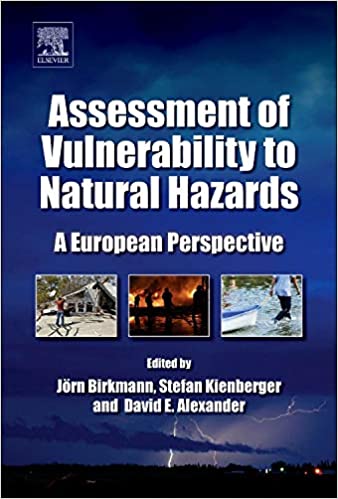
Assessment of Vulnerability to Natural Hazards covers the vulnerability of human and environmental systems to climate change and eight natural hazards: earthquakes, floods, landslides, avalanches, forest fires, drought, coastal erosion, and heat waves.
This book is an important contribution to the field, clarifying terms and investigating the nature of vulnerability to hazards in general and in various specific European contexts. In addition, this book helps improve understanding of vulnerability and gives thorough methodologies for investigating situations in which people and their environments are vulnerable to hazards. With case studies taken from across Europe, the underlying theoretical frame is transferrable to other geographical contexts, making the content relevant worldwide.
Shipping rates are calculated based on local US cities; international rates may apply for other countries.
by António José Bento Gonçalves(Editor), António Avelino Batista Vieira(Editor), Maria Rosário Melo Costa(Editor), José Tadeu Marques Aranha(Editor)
The present book intends to outline different approaches regarding wildland fires, showing different perspectives and challenges present in the beginning of the 21st century and emerging in different case studies that reveal how wildfires are being faced in some countries around the world (Portugal, Spain, Brazil, Algeria, Mozambique, Lithuania and Chile). Therefore, this book includes fifteen valuable contributions that reflect its title: Wildfires: Perspectives, Issues and Challenges of the 21st Century. The first part of this book includes topics that expresses different realities and challenges on wildfire analysis in Europe, South America and Africa, in a total of six chapters. The second part of this book, entitled “New Perspectives and Methodologies on Wildfire Research”, which is composed of five chapters, is focused on the implementation of recent techniques and methodologies to promote wildfire knowledge and forest management. The last part is related to recent developments on soils and ashes analysis, and their off-site effects on water quality. It is composed of four chapters where these topics are discussed.
Paperback – October 1, 2013
by War Department (Author)
The M2-2 flamethrower was an American portable backpack incendiary device that was used in World War II. It was the successor to the M1 and M1A1 flamethrowers and offered improved reliability and a more efficient ignition system than previous models. It had a "burn time" of around seven seconds and the flame was effective out to around thirty-three meters. In 1944, the M2-2 flamethrower was introduced into service. It was first used in combat in Guam and was thereafter employed in all Pacific campaigns. Flamethrowers proved highly effective in fighting against the Japanese, especially in routing defenders from caves, pillboxes and underground emplacements.The arrival of flamethrowing tanks, which offered personnel protection and more firepower, lessened the Army's interest in and tactical use of portable flamethrowers. The M2 was upgraded for use during the Korean War (M2A1-2) and Vietnam War (M2A1-7), and eventually replaced by the lightweight M9A1-7. However, these were shelved after 1978 when the Department of Defense unilaterally stopped using flamethrowers on the grounds that they are inhumane and have little combat value.Created in 1944, this field manual reveals a great deal about the M2-2’s design and capabilities. Intended as a training manual for those charged withoperation and maintenance, it details many aspects of its controls, tools andaccessories. Originally labeled restricted, this manual was declassified long ago and is here reprinted in book form. Care has been taken to preserve the integrity of the text.
Paperback – August 4, 2008
by David Carle(Author)
What is fire? How are wildfires ignited? How do California's weather and topography influence fire? How did the California Indians use fire? In the spirit of his highly acclaimed Introduction to Air in California and Introduction to Water in California, David Carle now turns to another fundamental element of the natural world, giving a fascinating and concise view of this complex topic. His clearly written, dramatically illustrated book will help Californians, including the millions who live near naturally flammable wildlands, better understand their own place in the state's landscape. Carle covers the basics of fire ecology; looks at the effects of fire on wildlife, soil, water, and air; discusses firefighting organizations and land management agencies; explains current policies; and explores many other topics.
Hardcover – January 1, 1938
by Shirley Walter Allen (Author)


There are no reviews yet.