
Product details
-
- Publisher : Elsevier; 1st edition (August 20, 2014)
- Language : English
- Hardcover : 240 pages
- ISBN-10 : 0124105289
- ISBN-13 : 978-0124105287
- Item Weight : 1.19 pounds
- Dimensions : 6.1 x 0.7 x 9.2 inches
$128.58
1st Edition
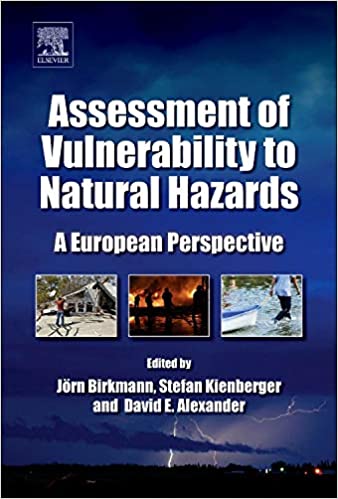
Assessment of Vulnerability to Natural Hazards covers the vulnerability of human and environmental systems to climate change and eight natural hazards: earthquakes, floods, landslides, avalanches, forest fires, drought, coastal erosion, and heat waves.
This book is an important contribution to the field, clarifying terms and investigating the nature of vulnerability to hazards in general and in various specific European contexts. In addition, this book helps improve understanding of vulnerability and gives thorough methodologies for investigating situations in which people and their environments are vulnerable to hazards. With case studies taken from across Europe, the underlying theoretical frame is transferrable to other geographical contexts, making the content relevant worldwide.
Shipping rates are calculated based on local US cities; international rates may apply for other countries.
1st Edition
Forest fires cause ecological, economic, and social damage to various states of the international community. The causes of forest fires are rather varied, but the main factor is human activity in settlements, industrial facilities, objects of transport infrastructure, and intensively developed territories (in other words, anthropogenic load). In turn, storm activity is also a basic reason for forest fires in remote territories. Therefore, scientists across the world have developed methods, approaches, and systems to predict forest fire danger, including the impact of human and storm activity on forested territories. An important and comprehensive point of research is on the complex deterministic-
2009th Edition
by F Stuart Chapin III(Editor), Gary P. Kofinas(Editor), Carl Folke(Editor), M.C. Chapin(Illustrator)
The world is undergoing unprecedented changes in many of the factors that determine its fundamental properties and their in- ence on society. These changes include climate; the chemical c- position of the atmosphere; the demands of a growing human population for food and ?ber; and the mobility of organisms, ind- trial products, cultural perspectives, and information ?ows. The magnitude and widespread nature of these changes pose serious challenges in managing the ecosystem services on which society depends. Moreover, many of these changes are strongly in?uenced by human activities, so future patterns of change will continue to be in?uenced by society’s choices and governance. The purpose of this book is to provide a new framework for n- ural resource management―a framework based on stewardship of ecosystems for human well-being in a world dominated by unc- tainty and change. The goal of ecosystem stewardship is to respond to and shape change in social-ecological systems in order to s- tain the supply and opportunities for use of ecosystem services by society. The book links recent advances in the theory of resilience, sustainability, and vulnerability with practical issues of ecosystem management and governance. The book is aimed at advanced undergraduates and beginning graduate students of natural resource management as well as professional managers, community leaders, and policy makers with backgrounds in a wide array of d- ciplines, including ecology, policy studies, economics, sociology, and anthropology
Paperback – October 12, 2013
by National Wildfire Coordinating Group (Author)
The objectives of this guide are to: Define and standardize national interagency operating procedures at large airtanker bases to ensure safe and efficient operations; Support fire policy through interagency coordination; Facilitate the exchange of personnel from all wildland fire suppression agencies during periods of high fire activity through standardization; Provide a common, interagency approach in the State, Federal, and Tribal Government’s contract related responsibilities; Provide common forms, checklists, orientations outlines, and special instructions for both contractor employees (retardant supplier personnel, pilots, mechanics) and government employees at airtanker bases; Provide a framework, which allows each airtanker base to provide a local base supplement with site specific guidance.
by António José Bento Gonçalves(Editor), António Avelino Batista Vieira(Editor), Maria Rosário Melo Costa(Editor), José Tadeu Marques Aranha(Editor)
The present book intends to outline different approaches regarding wildland fires, showing different perspectives and challenges present in the beginning of the 21st century and emerging in different case studies that reveal how wildfires are being faced in some countries around the world (Portugal, Spain, Brazil, Algeria, Mozambique, Lithuania and Chile). Therefore, this book includes fifteen valuable contributions that reflect its title: Wildfires: Perspectives, Issues and Challenges of the 21st Century. The first part of this book includes topics that expresses different realities and challenges on wildfire analysis in Europe, South America and Africa, in a total of six chapters. The second part of this book, entitled “New Perspectives and Methodologies on Wildfire Research”, which is composed of five chapters, is focused on the implementation of recent techniques and methodologies to promote wildfire knowledge and forest management. The last part is related to recent developments on soils and ashes analysis, and their off-site effects on water quality. It is composed of four chapters where these topics are discussed.
1st Edition
by Dean Lueck (Editor), Karen M. Bradshaw (Editor)
During the five decades since its origin, law and economics has provided an influential framework for addressing a wide array of areas of law ranging from judicial behaviour to contracts. This book will reflects the first-ever forum for law and economics scholars to apply the analysis and methodologies of their field to the subject of wildfire. The only modern legal work on wildfire, the book brings together leading scholars to consider questions such as: How can public policy address the effects of climate change on wildfire, and wildfire on climate change? Are the environmental and fiscal costs of ex ante prevention measures justified? What are the appropriate levels of prevention and suppression responsibility borne by private, state, and federal actors? Can tort liability provide a solution for realigning the grossly distorted incentives that currently exist for private landowners and government firefighters? Do the existing incentives in wildfire institutions provide incentives for efficient private and collective action and how might they be improved?



There are no reviews yet.