

Product details
- Publisher : Springer; 2001st edition (November 30, 2001)
- Language : English
- Hardcover : 444 pages
- ISBN-10 : 1402001231
- ISBN-13 : 978-1402001239
- Item Weight : 4.01 pounds
- Dimensions : 6.14 x 1 x 9.21 inches
$215.28
2001st Edition
by F. Bongers (Editor), P. Charles-Dominique (Editor), P.-M. Forget (Editor), Marc Théry (Editor)
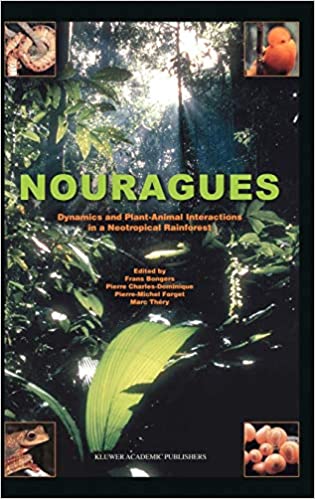
Nouragues is a tropical forest research station in French Guiana. It was established in 1986 for research on natural mechanisms of forest regeneration. Since then a lot of research has been done on this and related topics.
This book provides an overview of the main research results, and focuses on plant communities, vertebrate communities and evolutionary ecology, frugivory and seed dispersal, and forest dynamics and recruitment.
The appendices give (annoted) checklists of plants, birds, mammals, herpetofauna and fishes found in the same area.
Shipping rates are calculated based on local US cities; international rates may apply for other countries.
1st Edition
by R. Toby Pennington (Editor), James A. Ratter (Editor)
More often than not, when people think of a neotropical forest, what comes to mind is a rain forest, rather than a dry forest. Just as typically, when they imagine a savanna, they visualize the African plains, rather than those dry woodlands and grasslands found in the Neotropics. These same preconceptions can be found among scientists, as these neotropical biomes receive nowhere near the attention they should - in terms of both research and conservation -considering the amount of land they encompass and the diversity of vegetation they contain. Neotropical Savannas and Dry Forests: Plant Diversity, Biogeography, and Conservation provides an engaging synthesis of information on the plant diversity and geography, as well as the conservation status, of these species-rich areas. This impressive compilation is the result of a plant diversity symposium that took place during an international conference on tropical savannas and seasonally dry forests held in 2003. Fifty leading scientists, representing a variety of disciplines have contributed to the chapters of this book in an effort to address three questions:
Illustrated Edition
Illustrated Edition
by Rodolfo Dirzo (Author), Hillary S. Young (Author), Harold A. Mooney (Author), Gerardo Ceballos (Author)
Though seasonally dry tropical forests are equally as important to global biodiversity as tropical rainforests, and are one of the most representative and highly endangered ecosystems in Latin America, knowledge about them remains limited because of the relative paucity of attention paid to them by scientists and researchers and a lack of published information on the subject. Seasonally Dry Tropical Forests seeks to address this shortcoming by bringing together a range of experts in diverse fields including biology, ecology, biogeography, and biogeochemistry, to review, synthesize, and explain the current state of our collective knowledge on the ecology and conservation of seasonally dry tropical forests. The book offers a synthetic and cross-disciplinary review of recent work with an expansive scope, including sections on distribution, diversity, ecosystem function, and human impacts. Throughout, contributors emphasize conservation issues, particularly emerging threats and promising solutions, with key chapters on climate change, fragmentation, restoration, ecosystem services, and sustainable use. Seasonally dry tropical forests are extremely rich in biodiversity, and are seriously threatened. They represent scientific terrain that is poorly explored, and there is an urgent need for increased understanding of the system's basic ecology. Seasonally Dry Tropical Forests represents an important step in bringing together the most current scientific information about this vital ecosystem and disseminating it to the scientific and conservation communities
This Special Issue looks forward as well as backward to best analyze the forest conservation challenges of the Caribbean. This is made possible by 75 years of research and applications by the United States Department of Agriculture, International Institute of Tropical Forestry (the Institute) of Puerto Rico. It transforms Holocene-based scientific paradigms of the tropics into Anthropocene applications and outlooks of wilderness, managed forests, and urban environments. This volume showcases how the focus of the Institute's programs is evolving to support sustainable tropical forest conservation despite uncertain conditions. The manuscripts showcased here highlight the importance of shared stewardship and a long-term, hands-on approach to conservation, research programs, and novel organizations intended to meet contemporary conservation challenges. Policies relevant to the Anthropocene, as well as the use of experiments to anticipate future responses of tropical forests to global warming, are reexamined in these pages. Urban topics include how cities can co-produce new knowledge to spark sustainable and resilient transformations. Long-term results and research applications of topics such as soil biota, migratory birds, tropical vegetation, substrate chemistry, and the tropical carbon cycle are also described in the volume. Moreover, the question of how to best use land on a tropical island is addressed. This volume is intended to be of interest to all actors involved in long-term sustainable forest management and research in light of the historical lessons and future directions that may come out of a better understanding of tropical cities and forests in the Anthropocene epoch.
1st Edition
by Yadvinder Malhi (Editor), Oliver Phillips (Editor)
Tropical forests represent the world's most biodiverse ecosystems and play a key role in hydrology, carbon storage and exchange. Many of the human-induced pressures these regions are facing, e.g. fragmentation and deforestation, have been widely reported and well documented. However, there have been surprisingly few efforts to synthesize cutting-edge science in the area of tropical forest interaction with atmospheric change. At a time when our global atmosphere is undergoing a period of rapid change, both in terms of climate and in the cycling of essential elements such as carbon and nitrogen, a thorough and up-to-date analysis is now timely. This research level text, suitable for graduate level students as well as professional researchers in plant ecology, tropical forestry, climate change science, and conservation biology, explores the vigorous contemporary debate as to how rapidly tropical forests may be affected by atmospheric change, and what this may mean for their future.
First Edition
by William Allen (Author), Samantha Burton (Illustrator)
Can we prevent the destruction of the world's tropical forests? In the fire-scarred hills of Costa Rica, award-winning science writer William Allen found a remarkable answer: we can not only prevent their destruction--we can bring them back to their former glory. In Green Phoenix, Allen tells the gripping story of a large group of Costa Rican and American scientists and volunteers who set out to save the tropical forests in the northwestern section of the country. It was an area badly damaged by the fires of ranchers and small farmers; in many places a few strands of forest strung across a charred landscape. Despite the widely held belief that tropical forests, once lost, are lost forever, the team led by the dynamic Daniel Janzen from the University of Pennsylvania moved relentlessly ahead, taking a broad array of political, ecological, and social steps necessary for restoration. They began with 39 square miles and, by 2000, they had stitched together and revived some 463 square miles of land and another 290 of marine area. Today this region is known as the Guanacaste Conservation Area, a fabulously rich landscape of dry forest, cloud forest, and rain forest that gives life to some 235,000 species of plants and animals. It may be the greatest environmental success of our time, a prime example of how extensive devastation can be halted and reversed. This is an inspiring story, and in recounting it, Allen writes with vivid power. He creates lasting images of pristine beaches and dense forest and captures the heroics and skill of the scientific teams, especially the larger-than-life personality of the maverick ecologist Daniel Janzen. It is a book everyone concerned about the environment will want to own.


There are no reviews yet.