
Product details
- Publisher : Island Press; 0002- edition (March 1, 1996)
- Language : English
- Paperback : 505 pages
- ISBN-10 : 1559632305
- ISBN-13 : 978-1559632300
- Item Weight : 1.84 pounds
- Dimensions : 6 x 1.6 x 9 inches
$63.00
0002- Edition
by James K Agee (Author)
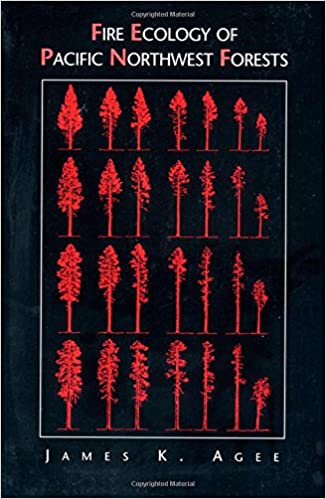
It was once widely believed that landscapes become increasingly stable over time until eventually reaching a climax state of complete stability. In recent years, however, that idea has been challenged by a new understanding of the importance and inevitability of forces such as storms and fires that keep ecosystems in a state of constant change. The dynamics of fire ecology has emerged as a central feature of the new understanding as scientists and land managers redefine traditional assumptions about the growth and development of ecosystems. Fire Ecology of Pacific Northwest Forests is a historical, analytical, and ecological approach to the effects and use of fire in Pacific Northwest wildlands. James K. Agee, a leading expert in the emerging field of fire ecology, analyzes the ecological role of fire in the creation and maintenance of the natural forests common to most of the western United States. In addition to examining fire from an ecological perspective, he provides insight into its historical and cultural aspects, and also touches on some of the political issues that influence the use and control of fire in the United States. In addition to serving as a sourcebook for natural area managers interested in restoring or maintaining fire regimes in Pacific Northwest wildlands, this volume provides an essential base of knowledge for all others interested in wildland management who wish to understand the ecological effects of fire. Although the chapters on the ecology of specific forest zones focus on the Pacific Northwest, much of the book addresses issues not unique to that region
Shipping rates are calculated based on local US cities; international rates may apply for other countries.
Paperback – April 18, 2011
by S Haberle (Author), J Stevenson (Author), M Prebble (Author)
Like a star chart this volume orientates the reader to the key issues and debates in Pacific and Australasian biogeography, palaeoecology and human ecology. A feature of this collection is the diversity of approaches ranging from interpretation of the biogeographic significance of plant and animal distributional patterns, pollen analysis from peats and lake sediments to discern Quaternary climate change, explanation of the patterns of faunal extinction events, the interplay of fire on landscape evolution, and models of the environmental consequences of human settlement patterns. The diversity of approaches, geographic scope and academic rigor are a fitting tribute to the enormous contributions of Geoff Hope. As made apparent in this volume, Hope pioneered multidisciplinary understanding of the history and impacts of human cultures in the Australia- Pacific region, arguably the globe’s premier model systems for understanding the consequences of humans colonization on ecological systems. The distinguished scholars who have contributed to this volume also demonstrate Hope’s enduring contribution as an inspirational research leader, collaborator and mentor. Terra Australis leave no doubt that history matters, not only for land management, but more importantly, in alerting settler and indigenous societies alike to their past ecological impacts and future environmental trajectories
Paperback
(Series; 16) 1995th Edition
by O.W. Archibold (Author)
The ecology of world vegetation is described in numer all of the drafting and photographic work. They have ous books and journals, but these are usually very spe spent many hours on this project and their care and skill cialized in their scope and treatment. This book provides is reflected in the consistently high quality of the illus a synthesis of this literature. A brief introductory chap trations throughout the book. Many friends and col ter outlines general ecological concepts and subsequent leagues have provided photographs. It has not been chapters examine the form and function of the major possible to include all of them, but the 'global' perspect biomes of the world. A similar organization has been ive of the book has been greatly enhanced in this way. used for each biome type. These chapters begin with a I wish to thank them all for the time and trouble they description of environmental conditions and a brief have taken to supply this material. I must also thank account of floristic diversity in a regional context. The Mary Dykes and the staff of the interlibrary loans de remaining pages describe characteristic adaptations and partment of the Library, University of Saskatchewan, ecosystem processes. for their unfailing ability to get even the most obscure Although there is a rapidly growing literature on eco references.
Hardcover – May 29, 2015
There are no reviews yet.