Product details
-
-
- ASIN : B00087J4S4
- Publisher : OSC Cooperative Association (January 1, 1939)
- Language : English
- Unknown Binding : 184 pages
-

Unknown Binding – January 1, 1939
Shipping rates are calculated based on local US cities; international rates may apply for other countries.
Paperback – September 26, 2011
1st Edition
Forest fires cause ecological, economic, and social damage to various states of the international community. The causes of forest fires are rather varied, but the main factor is human activity in settlements, industrial facilities, objects of transport infrastructure, and intensively developed territories (in other words, anthropogenic load). In turn, storm activity is also a basic reason for forest fires in remote territories. Therefore, scientists across the world have developed methods, approaches, and systems to predict forest fire danger, including the impact of human and storm activity on forested territories. An important and comprehensive point of research is on the complex deterministic-
Paperback – October 1, 2013
by War Department (Author)
The M2-2 flamethrower was an American portable backpack incendiary device that was used in World War II. It was the successor to the M1 and M1A1 flamethrowers and offered improved reliability and a more efficient ignition system than previous models. It had a "burn time" of around seven seconds and the flame was effective out to around thirty-three meters. In 1944, the M2-2 flamethrower was introduced into service. It was first used in combat in Guam and was thereafter employed in all Pacific campaigns. Flamethrowers proved highly effective in fighting against the Japanese, especially in routing defenders from caves, pillboxes and underground emplacements.The arrival of flamethrowing tanks, which offered personnel protection and more firepower, lessened the Army's interest in and tactical use of portable flamethrowers. The M2 was upgraded for use during the Korean War (M2A1-2) and Vietnam War (M2A1-7), and eventually replaced by the lightweight M9A1-7. However, these were shelved after 1978 when the Department of Defense unilaterally stopped using flamethrowers on the grounds that they are inhumane and have little combat value.Created in 1944, this field manual reveals a great deal about the M2-2’s design and capabilities. Intended as a training manual for those charged withoperation and maintenance, it details many aspects of its controls, tools andaccessories. Originally labeled restricted, this manual was declassified long ago and is here reprinted in book form. Care has been taken to preserve the integrity of the text.
Kindle Edition
by David Chorlton (Author), Julie Comnick (Illustrator) Format: Kindle Edition
The Flagstaff Arts Council selected 10 artists and a poet to contribute to an exhibition addressing the role of fire in forest management. In September of 2014 the group visited the North Rim of the Grand Canyon where numerous fire managers, ecologists, and fighters, spoke about the past, present, and potential futures of fire on the Colorado Plateau. David Chorlton was the poet, and A Field Guide to Fire is the collection of poems he wrote. The book also contains charcoal drawings by Julie Comnick, one of the artists. The poems draw on historic as well as contemporary sources to reflect on differing cultural attitudes toward the use of fire in forests, and they address ecology in the age of climate change. The exhibition, Fires of Change, was conceived as a collaboration between science and art. A Field Guide to Fire is a lyrical response, beautifully balanced by visual art.
Unknown Binding – January 1, 1993
by Doug Campbell (Author)
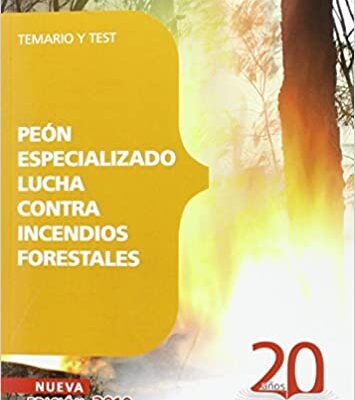
(Spanish Edition) Paperback – June 23, 2010
Spanish Edition by Sin datos (Author)
El presente manual es un temario de carácter general en el que se contiene una selección de materias cuyo conocimiento se exige a los aspirantes a ingresar en los Cuerpos de Peones Especializados en la lucha contra Incendios Forestales al servicio de las


There are no reviews yet.