Product details
- Publisher : Fire Protection Publications; 4th edition (January 1, 2018)
- Language : English
- Paperback : 588 pages
- ISBN-10 : 0879396768
- ISBN-13 : 978-0879396763
- Item Weight : 3.59 pounds
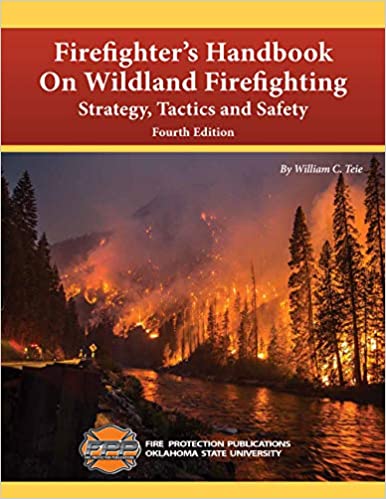
$70.00
Paperback – January 1, 2018
by William C. Teie(Author)
The NEW 4th Edition of this bestselling book by noted wildland firefighting author, Bill Teie is updated to address the most current NFPA and National Wildfire Coordinating Group (NWCG) standards and qualifications for wildland firefighting. This book is written for the fire personnel who need a basic understanding of wildland firefighting. Firefighters and fire officers who have primary wildland responsibilities and who may be called into a wildland fire situation as a mutual aid response will all find this handbook valuable. This handbook combines critical components from the 2016 edition of NFPA 1051 and NWCG documents into one source for wildland firefighters, officers and command staff. The NFPA and NWCG documents are referenced at the front of each chapter. The NEW edition now includes a Fireline Construction chapter. The content is sequenced to logically build competency from the first through all 15 chapters of the book.
Shipping rates are calculated based on local US cities; international rates may apply for other countries.
1st Edition
Forest fires cause ecological, economic, and social damage to various states of the international community. The causes of forest fires are rather varied, but the main factor is human activity in settlements, industrial facilities, objects of transport infrastructure, and intensively developed territories (in other words, anthropogenic load). In turn, storm activity is also a basic reason for forest fires in remote territories. Therefore, scientists across the world have developed methods, approaches, and systems to predict forest fire danger, including the impact of human and storm activity on forested territories. An important and comprehensive point of research is on the complex deterministic-
Paperback – January 1, 1796
Paperback – August 4, 2008
by David Carle(Author)
What is fire? How are wildfires ignited? How do California's weather and topography influence fire? How did the California Indians use fire? In the spirit of his highly acclaimed Introduction to Air in California and Introduction to Water in California, David Carle now turns to another fundamental element of the natural world, giving a fascinating and concise view of this complex topic. His clearly written, dramatically illustrated book will help Californians, including the millions who live near naturally flammable wildlands, better understand their own place in the state's landscape. Carle covers the basics of fire ecology; looks at the effects of fire on wildlife, soil, water, and air; discusses firefighting organizations and land management agencies; explains current policies; and explores many other topics.
Kindle Edition
Spanish Edition by Varios Autores (Author) Format: Kindle Edition
Gestión y restauración de ecosistemas forestales tras los incendios. Nuevos retos y avances para el desarrollo rural. Universitat de València (PUV) es la difusión de la producción científica, e intelectual en sentido más general, generada en la Universitat de València a través de los procedimientos habituales del proceso editorial, es decir, de la confección de libros y revistas. Más allá de este aspecto relacionado con la comunicación científica tiene una gran relevancia la proyección social y cultural de la actividad universitaria potenciando el binomino universidad y sociedad.
Hardcover – December 31, 1979
by S. S. Ajayi (Author), Lambert Beverley Halstead (Author)
Illustrated Edition, Kindle Edition
by Stephen F. Arno (Author), Carl E. Fiedler (Author) Format: Kindle Edition
The magnificent stands of old-growth trees that characterize the forests of western North America depend on periodic fires for their creation or survival. Deprived of that essential disturbance process eventually they die, leaving an overcrowded growth of smaller trees vulnerable to intense blazes and epidemics of insects and disease. In Mimicking Nature's Fire, forest ecologists Stephen Arno and Carl Fiedler present practical solutions to the pervasive problem of deteriorating forest conditions in western North America. Advocating a new direction in forest management, they explore the promise of "restoration forestry" -- an ecologically based approach that seeks to establish forest structures in which fire can once again serve as a beneficial process rather than as a destructive aberration. The book begins with an overview of fundamentals: why traditional forestry tried to exclude fire from forests, why that attempt failed, and why foresters and ecologists now recognize the need for management based on how natural ecosystems operate. Subsequent chapters consider: how fire's historic role provides a foundation for designing restoration strategies; why a hands-off approach will not return forests to their historical condition; how management goals influence the strategies used in restoration forestry. The second part of the book presents case studies of restoration projects in the western United States and Canada, representing different forest types, different historic fire regimes, and contrasting management goals. For each project, the authors describe why and how the project is being conducted, profile forest conditions, and describe methods of treatment. They also report what has been accomplished, identify obstacles to restoration, and offer their candid but understanding evaluation. Mimicking Nature's Fire concludes by placing restoration forestry in the broad context of conserving forests worldwide and outlining factors critical for its success.


There are no reviews yet.