

Product details
- Publisher : Island Press; 0002- edition (March 1, 1996)
- Language : English
- Paperback : 505 pages
- ISBN-10 : 1559632305
- ISBN-13 : 978-1559632300
- Item Weight : 1.84 pounds
- Dimensions : 6 x 1.6 x 9 inches
$63.00
0002- Edition
by James K Agee (Author)
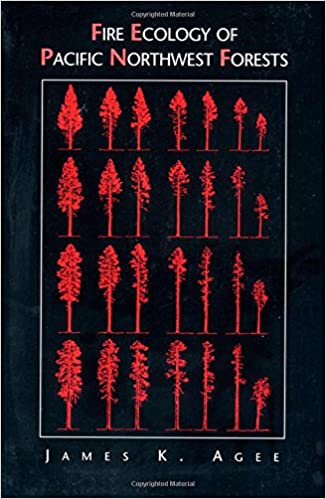
It was once widely believed that landscapes become increasingly stable over time until eventually reaching a climax state of complete stability. In recent years, however, that idea has been challenged by a new understanding of the importance and inevitability of forces such as storms and fires that keep ecosystems in a state of constant change. The dynamics of fire ecology has emerged as a central feature of the new understanding as scientists and land managers redefine traditional assumptions about the growth and development of ecosystems. Fire Ecology of Pacific Northwest Forests is a historical, analytical, and ecological approach to the effects and use of fire in Pacific Northwest wildlands. James K. Agee, a leading expert in the emerging field of fire ecology, analyzes the ecological role of fire in the creation and maintenance of the natural forests common to most of the western United States. In addition to examining fire from an ecological perspective, he provides insight into its historical and cultural aspects, and also touches on some of the political issues that influence the use and control of fire in the United States. In addition to serving as a sourcebook for natural area managers interested in restoring or maintaining fire regimes in Pacific Northwest wildlands, this volume provides an essential base of knowledge for all others interested in wildland management who wish to understand the ecological effects of fire. Although the chapters on the ecology of specific forest zones focus on the Pacific Northwest, much of the book addresses issues not unique to that region
Shipping rates are calculated based on local US cities; international rates may apply for other countries.
Hardcover – January 1, 1989
by James K. Agee (Editor), Darryll R. Johnson (Editor)
The need for cooperation among government agencies as well as an interdisciplinary approach to the increasingly challenging and complicated problem of managing park and wilderness areas prompted the University of Washington College of Forest Resources, the National Park Service, and the Forest Service to sponsor an ecosystem management workshop for scientists, planners, and managers. To develop an improved conceptual approach to managing change in ecosystems crossing natural and political boundaries, the workshop focused on defining terms, uncovering areas of misunderstanding and barriers to cooperation, and developing methods to determine the most important problems and issues. Three needs emerged from the prioritization process: a precise definition of the management objectives for park and wilderness lands and how to integrate them with objectives for surrounding lands, nationally as well as site-specific; more information about physical, biological, and social components of park and wilderness ecosystems from both sides of political boundaries; and key indicators of ecosystem condition as well as methods for evaluating management effectiveness. All of these common themes point to a need for more precise direction in management goal setting and more accurate assessment of progress toward goals. The book includes an introductory chapter by the editors and summary in which they outline a direction for ecosystem management in the next critical decades. The other chapters by individual contributors include studies on laws governing park and wilderness lands, paleoecological records that reveal the historic effects of climatic variations on vegetation change, succession and natural disturbance in relation to the problems of what can and should be preserved, managing ecosystems for large populations of vertebrates, the management of large carnivores, effects of air pollution, lake acidification, human ecology and environmental management, the role of economics, cooperation in ecosystem management, and management challenges in Yellowstone National Park.Paperback
(Series; 16) 1995th Edition
by O.W. Archibold (Author)
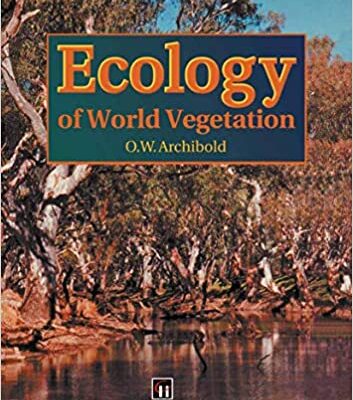
The ecology of world vegetation is described in numer all of the drafting and photographic work. They have ous books and journals, but these are usually very spe spent many hours on this project and their care and skill cialized in their scope and treatment. This book provides is reflected in the consistently high quality of the illus a synthesis of this literature. A brief introductory chap trations throughout the book. Many friends and col ter outlines general ecological concepts and subsequent leagues have provided photographs. It has not been chapters examine the form and function of the major possible to include all of them, but the 'global' perspect biomes of the world. A similar organization has been ive of the book has been greatly enhanced in this way. used for each biome type. These chapters begin with a I wish to thank them all for the time and trouble they description of environmental conditions and a brief have taken to supply this material. I must also thank account of floristic diversity in a regional context. The Mary Dykes and the staff of the interlibrary loans de remaining pages describe characteristic adaptations and partment of the Library, University of Saskatchewan, ecosystem processes. for their unfailing ability to get even the most obscure Although there is a rapidly growing literature on eco references.
(Tasks for Vegetation Science, 31) Softcover reprint of the original 1st ed. 1994 Edition
by Margarita Arianoutsou-Faraggitaki (Editor), R.H. Groves (Editor)
The Sixth International Conference on Mediterranean Climate ecosystems was held at Maleme (Crete), Greece, from September 23 to September 27, 1991. This conference had as its theme 'Plant-Animal Interactions in Mediterranean-type Ecosystems'. Most of the papers presented to that meeting have already been published (see Thanos, C.A. ed., 1992, Proceedings of the VI International Conference on Mediterranean Climate Ecosystems, Athens, 389 pp.). These 57 papers were all necessarily short. But the theme of plant-animal interactions was considered by the Organizing Committee to be so important to a fundamental understanding of the ecology of Mediterranean-climate ecosystems and to an enhanced management ·of those systems that various international research scientists were invited to prepare longer contributions on major aspects of the overall theme. The Book that follows represents the result of those invitations. All five regions of Mediterranean climate are represented - Chile, California, southern Australia and the Cape Province of South Africa, as well as the Mediterranean Basin itself.
1st Edition
by Lee E. Frelich (Author)
Lee Frelich provides a major contribution to the study of temperate-zone forest dynamics by considering three important themes: the combined influence of wind, fire, and herbivory on the successional trajectories and structural characteristics of forests; the interaction of deciduous and evergreen tree species to form mosiacs; and the significance of temporal and spatial scale with regard to the overall impact of disturbances. These themes are explored via case studies from the forests in the Lake States of Minnesota, Wisconsin and Michigan, where the presence of large primary forest remnants provides a unique opportunity to study the long-term dynamics of near-boreal, pine, and hardwood-hemlock forests.
st ed. 2016 Edition

There are no reviews yet.