
Product details
- Publisher : Island Press; 2nd ed. edition (May 29, 2012)
- Language : English
- Hardcover : 392 pages
- ISBN-10 : 1610911709
- ISBN-13 : 978-1610911702
- Item Weight : 1.92 pounds
- Dimensions : 7 x 1.1 x 10 inches
$74.00
2nd ed. Edition
by Jodi A. Hilty(Editor), Charles C. Chester (Editor), Molly S. Cross(Editor)
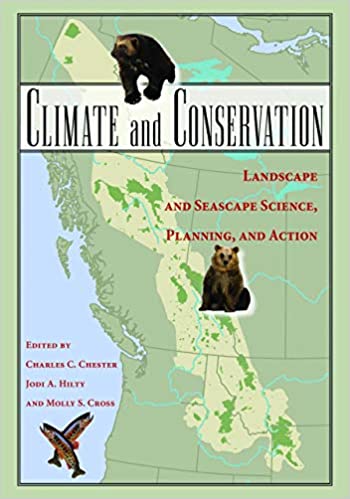
Climate and Conservation presents case studies from around the world of leading-edge projects focused on climate change adaptation-regional-scale endeavors where scientists, managers, and practitioners are working to protect biodiversity by protecting landscapes and seascapes in response to threats posed by climate change.
The book begins with an introductory section that frames the issues and takes a systematic look at planning for climate change adaptation. The nineteen chapters that follow examine particular case studies in every part of the world, including landscapes and seascapes from equatorial, temperate, montane, polar, and marine and freshwater regions. Projects profiled range from North American grasslands to boreal forests to coral reefs to Alpine freshwater environments.
Chapter authors have extensive experience in their respective regions and are actively engaged in working on climate-related issues. The result is a collection of geographical case studies that allows for effective cross-comparison while at the same time recognizing the uniqueness of each situation and locale.
Climate and Conservation offers readers tangible, place-based examples of projects designed to protect large landscapes as a means of conserving biodiversity in the face of the looming threat of global climate change. It informs readers of how a diverse set of conservation actors have been responding to climate change at a scale that matches the problem, and is an essential contribution for anyone involved with large-scale biodiversity conservation.
Shipping rates are calculated based on local US cities; international rates may apply for other countries.
1st Edition
by Richard G. Zepp (Editor)
A diverse group of eminent contributors describe a variety of aspects regarding climate-biosphere interactions most susceptible to human perturbations. Models related to climate change and the carbon cycle, biogenic emissions of greenhouse gases in China not concerned with rice cultivation and environmental effects of climate change are among the subjects covered. Although climate-biosphere interactions in China are emphasized, the approaches and scientific principles discussed are designed to provide readers with a general understanding of the processes and data needed to comprehend these interactions.
Hardcover – January 1, 1949
By : Aubreville, a. m. a.2000th Edition
by Eric S. Kasischke (Editor), Brian J. Stocks (Editor)
A discussion of the direct and indirect mechanisms by which fire and climate interact to influence carbon cycling in North American boreal forests. The first section summarizes the information needed to understand and manage fires' effects on the ecology of boreal forests and its influence on global climate change issues. Following chapters discuss in detail the role of fire in the ecology of boreal forests, present data sets on fire and the distribution of carbon, and treat the use of satellite imagery in monitoring these regions as well as approaches to modeling the relevant processes.
Abridged, January 1, 1987
by Martin A. Uman (Author)
Does lightning strike twice in the same place? How does a lightning rod work? What is ball lightning? How many thunderstorms are in progress in the world at any one time? Why does lightning zigzag? What is St. Elmo's Fire? These and many more often-asked questions about lightning are answered in this fascinating and informative guide for the layman, presented in an easy-to-follow question-and-answer format. One of nature's most awesome phenomena, lightning has intrigued man since earliest times. In this book, a noted scientist and expert on lightning dispels many misconceptions while offering a wealth of scientific and technical information about the nature of lightning and its effects. You'll discover how Benjamin Franklin proved that lightning was electrical, how to protect yourself from lightning, how to photograph lightning (it's not difficult), the possible relationship between ball lightning and UFOs, what to do for a person struck by lightning, the nature of sheet lightning, ribbon lightning, bead lightning and other variations, and much more. While the overall approach is nontechnical, Dr. U man has incorporated scientific data in the answers in such a way that laymen will find the book a near-painless introduction to current scientific knowledge about lightning. Simple, well-drawn diagrams illuminate the text, along with a selection of spectacular lightning photographs, including a remarkable image of 5 lightning bolts produced by the explosion of the first thermonuclear device. In addition, each chapter contains a list of references cited in the text which suggest further reading for anyone interested in finding out more about earth's dazzling atmospheric fireworks.
(Ecological Studies, 222) 2015th Edition
by Daniel G. Gavin (Author), Linda B. Brubaker (Author)
This study brings together decades of research on the modern natural environment of Washington's Olympic Peninsula, reviews past research on paleoenvironmental change since the Late Pleistocene, and finally presents paleoecological records of changing forest composition and fire over the last 14,000 years. The focus of this study is on the authors’ studies of five pollen records from the Olympic Peninsula. Maps and other data graphics are used extensively. Paleoecology can effectively address some of these challenges we face in understanding the biotic response to climate change and other agents of change in ecosystems. First, species responses to climate change are mediated by changing disturbance regimes. Second, biotic hotspots today suggest a long-term maintenance of diversity in an area, and researchers approach the maintenance of diversity from a wide range and angles (CITE). Mountain regions may maintain biodiversity through significant climate change in ‘refugia’: locations where components of diversity retreat to and expand from during periods of unfavorable climate (Keppel et al., 2012). Paleoecological studies can describe the context for which biodiversity persisted through time climate refugia. Third, the paleoecological approach is especially suited for long-lived organisms. For example, a tree species that may typically reach reproductive sizes only after 50 years and remain fertile for 300 years, will experience only 30 to 200 generations since colonizing a location after Holocene warming about 11,000 years ago. Thus, by summarizing community change through multiple generations and natural disturbance events, paleoecological studies can examine the resilience of ecosystems to disturbances in the past, showing how many ecosystems recover quickly while others may not (Willis et al., 2010)
2003rd Edition, Kindle Edition
by Thomas T. Veblen (Editor), William L. Baker (Editor), Gloria Montenegro (Editor), Thomas W. Swetnam (Editor) Format: Kindle Edition
Both fire and climatic variability have monumental impacts on the dynamics of temperate ecosystems. These impacts can sometimes be extreme or devastating as seen in recent El Nino/La Nina cycles and in uncontrolled fire occurrences. This volume brings together research conducted in western North and South America, areas of a great deal of collaborative work on the influence of people and climate change on fire regimes. In order to give perspective to patterns of change over time, it emphasizes the integration of paleoecological studies with studies of modern ecosystems. Data from a range of spatial scales, from individual plants to communities and ecosystems to landscape and regional levels, are included. Contributions come from fire ecology, paleoecology, biogeography, paleoclimatology, landscape and ecosystem ecology, ecological modeling, forest management, plant community ecology and plant morphology. The book gives a synthetic overview of methods, data and simulation models for evaluating fire regime processes in forests, shrublands and woodlands and assembles case studies of fire, climate and land use histories. The unique approach of this book gives researchers the benefits of a north-south comparison as well as the integration of paleoecological histories, current ecosystem dynamics and modeling of future changes.


There are no reviews yet.