Product details
- Publisher : Harbour Publishing (October 13, 2020)
- Language : English
- Paperback : 304 pages
- ISBN-10 : 1550178946
- ISBN-13 : 978-1550178944
- Item Weight : 1.2 pounds
- Dimensions : 6 x 0.68 x 9 inches
$14.15
Paperback – October 13, 2020
by Claudia Cornwall (Author)
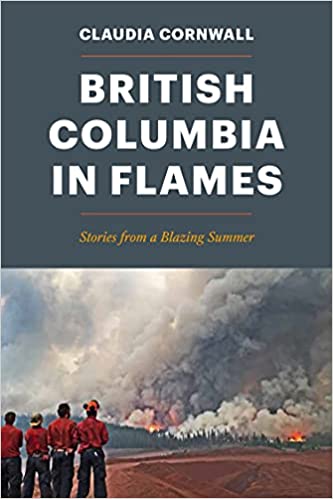
Like many British Columbians in 2017, Claudia Cornwall found herself glued to the news about the disastrous wildfires across the province. Her worry was personal: her cabin at Sheridan Lake had been in the family for sixty years and was now in danger of destruction.
Cornwall, a long-time writer, was stricken not just by her own experience, but by the many moving stories she came across about the fires―so she began collecting them. She met with people from the communities of Sheridan Lake, Ashcroft, Cache Creek, 16 Mile House, Lac La Hache, Quesnel, Williams Lake, Hanceville-Riske Creek and Clinton. She hoped to be a conduit for the voices she heard―for those who fought the fires raging around them, those who were evacuated and displaced, and those who could do nothing but watch as their homes burned. She conducted over fifty hours of interviews with ranchers, cottagers, Indigenous residents, RCMP officers, evacuees, store and resort owners, search and rescue volunteers, firefighters and local government officials.
Presented in British Columbia in Flames are stories that illustrate the importance of community. During the 2017 wildfires, people looked after strangers who had no place to go. They shared information. They helped each other rescue and shelter animals. They kept stores open day and night to supply gas, food and comfort to evacuees. This memoir, at once journalistic and deeply personal, highlights the strength with which BC communities can and will come together to face a terrifying force of nature.
Shipping rates are calculated based on local US cities; international rates may apply for other countries.
Illustrated Edition, Kindle Edition
by Stephen F. Arno (Author), Carl E. Fiedler (Author) Format: Kindle Edition
The magnificent stands of old-growth trees that characterize the forests of western North America depend on periodic fires for their creation or survival. Deprived of that essential disturbance process eventually they die, leaving an overcrowded growth of smaller trees vulnerable to intense blazes and epidemics of insects and disease. In Mimicking Nature's Fire, forest ecologists Stephen Arno and Carl Fiedler present practical solutions to the pervasive problem of deteriorating forest conditions in western North America. Advocating a new direction in forest management, they explore the promise of "restoration forestry" -- an ecologically based approach that seeks to establish forest structures in which fire can once again serve as a beneficial process rather than as a destructive aberration. The book begins with an overview of fundamentals: why traditional forestry tried to exclude fire from forests, why that attempt failed, and why foresters and ecologists now recognize the need for management based on how natural ecosystems operate. Subsequent chapters consider: how fire's historic role provides a foundation for designing restoration strategies; why a hands-off approach will not return forests to their historical condition; how management goals influence the strategies used in restoration forestry. The second part of the book presents case studies of restoration projects in the western United States and Canada, representing different forest types, different historic fire regimes, and contrasting management goals. For each project, the authors describe why and how the project is being conducted, profile forest conditions, and describe methods of treatment. They also report what has been accomplished, identify obstacles to restoration, and offer their candid but understanding evaluation. Mimicking Nature's Fire concludes by placing restoration forestry in the broad context of conserving forests worldwide and outlining factors critical for its success.(Spanish Edition) Paperback – June 23, 2010
Spanish Edition by Sin datos (Author)
El presente manual es un temario de carácter general en el que se contiene una selección de materias cuyo conocimiento se exige a los aspirantes a ingresar en los Cuerpos de Peones Especializados en la lucha contra Incendios Forestales al servicio de las
Paperback – April 8, 2008
by Kevin Baum(Author)
Why are firefighters so universally valued? How is it that a home can burn to the ground, yet the owners still bring the responding firefighters milk and cookies, give them hugs, and tell them thank you? While much can be written about the fire service in a post-9/11 world, one truth is constant: their customers love them. Why is that? Are there lessons for leaders or managers that can be extracted from this profession and applied to general organizational life? What would your organization gain if your customers loved you, your products, and your services? Author and management consultant Kevin Baum explores these questions and more in Lessons from the Line. Adding his twenty years' experience as a professional firefighter and chief officer to his work with organizations around the world, Kevin drills into the unique profession of firefighting to build a practical tool for organizational and leadership development-the Firefighter Model. A unique blend of management and leadership practices, this innovative model can be applied to organizations of any size, with any mission, in any place. Lessons from the Line is a fast-paced, real-world look at organizational life from the firefighter's perspective that will give you the tools to create an organization of heroes.
1st Edition
Forest fires cause ecological, economic, and social damage to various states of the international community. The causes of forest fires are rather varied, but the main factor is human activity in settlements, industrial facilities, objects of transport infrastructure, and intensively developed territories (in other words, anthropogenic load). In turn, storm activity is also a basic reason for forest fires in remote territories. Therefore, scientists across the world have developed methods, approaches, and systems to predict forest fire danger, including the impact of human and storm activity on forested territories. An important and comprehensive point of research is on the complex deterministic-
Unknown Binding – January 1, 1993
by Doug Campbell (Author)
by António José Bento Gonçalves(Editor), António Avelino Batista Vieira(Editor), Maria Rosário Melo Costa(Editor), José Tadeu Marques Aranha(Editor)
The present book intends to outline different approaches regarding wildland fires, showing different perspectives and challenges present in the beginning of the 21st century and emerging in different case studies that reveal how wildfires are being faced in some countries around the world (Portugal, Spain, Brazil, Algeria, Mozambique, Lithuania and Chile). Therefore, this book includes fifteen valuable contributions that reflect its title: Wildfires: Perspectives, Issues and Challenges of the 21st Century. The first part of this book includes topics that expresses different realities and challenges on wildfire analysis in Europe, South America and Africa, in a total of six chapters. The second part of this book, entitled “New Perspectives and Methodologies on Wildfire Research”, which is composed of five chapters, is focused on the implementation of recent techniques and methodologies to promote wildfire knowledge and forest management. The last part is related to recent developments on soils and ashes analysis, and their off-site effects on water quality. It is composed of four chapters where these topics are discussed.
There are no reviews yet.