
Product details
- Publisher : University of Arizona Press (April 21, 2020)
- Language : English
- Paperback : 448 pages
- ISBN-10 : 0816540128
- ISBN-13 : 978-0816540129
- Item Weight : 1.32 pounds
- Dimensions : 6 x 1.1 x 9 inches
$24.88
Paperback – April 21, 2020
by Stephen J. Pyne (Author)
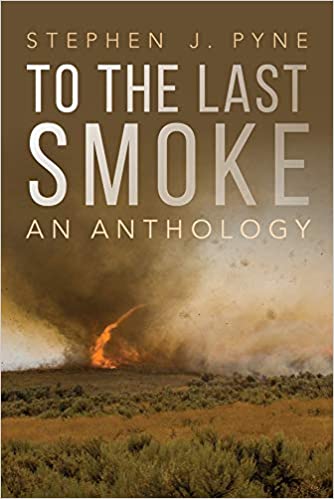
From boreal Alaska to subtropical Florida, from the chaparral of California to the pitch pine of New Jersey, America boasts nearly a billion burnable acres. In nine previous volumes, Stephen J. Pyne has explored the fascinating variety of flame region by region. In To the Last Smoke: An Anthology, he selects a sampling of the best from each.
To the Last Smoke offers a unique and sweeping view of the nation’s fire scene by distilling observations on Florida, California, the Northern Rockies, the Great Plains, the Southwest, the Interior West, the Northeast, Alaska, the oak woodlands, and the Pacific Northwest into a single, readable volume. The anthology functions as a color-commentary companion to the play-by-play narrative offered in Pyne’s Between Two Fires: A Fire History of Contemporary America. The series is Pyne’s way of “keeping with it to the end,” encompassing the directive from his rookie season to stay with every fire “to the last smoke.”
Shipping rates are calculated based on local US cities; international rates may apply for other countries.
Paperback – Illustrated, February 1, 2016
by Daniel Brown (Author)
On September 1, 1894 two forest fires converged on the town of Hinckley, Minnesota, trapping over 2,000 people. Daniel J. Brown recounts the events surrounding the fire in the first and only book on to chronicle the dramatic story that unfolded. Whereas Oregon's famous "Biscuit" fire in 2002 burned 350,000 acres in one week, the Hinckley fire did the same damage in five hours. The fire created its own weather, including hurricane-strength winds, bubbles of plasma-like glowing gas, and 200-foot-tall flames. In some instances, "fire whirls," or tornadoes of fire, danced out from the main body of the fire to knock down buildings and carry flaming debris into the sky. Temperatures reached 1,600 degrees Fahrenheit--the melting point of steel.As the fire surrounded the town, two railroads became the only means of escape. Two trains ran the gauntlet of fire. One train caught on fire from one end to the other. The heroic young African-American porter ran up and down the length of the train, reassuring the passengers even as the flames tore at their clothes. On the other train, the engineer refused to back his locomotive out of town until the last possible minute of escape. In all, more than 400 people died, leading to a revolution in forestry management practices and federal agencies that monitor and fight wildfires today. Author Daniel Brown has woven together numerous survivors' stories, historical sources, and interviews with forest fire experts in a gripping narrative that tells the fascinating story of one of North America's most devastating fires and how it changed the nation.
Paperback – September 1, 2019
by Curt Brown (Author)
In 1918, Minnesota and its residents were confronted with a series of devastating events that put communities to the test, forcing them to persevere through untold hardship. First, as the nation immersed itself in the global conflict later known as World War I, some 118,000 Minnesotans served in the war effort, both at home and "over there"–and citizens on the home front were subjected to loyalty tests and new depths of government surveillance. While more than 1,400 Minnesotans were killed on the battlefields, an additional 2,300 soldiers were struck down by another destructive force working its way across the globe in 1918: the influenza pandemic, which left more than 10,000 dead in Minnesota alone. Then, in mid-October, fires raged across 1,500 square miles in seven counties of northeastern Minnesota, leaving thousands homeless and hundreds dead. In Minnesota, 1918, journalist and author Curt Brown explores this monumental year through individual and community stories from all over the state, from residents of small towns up north obliterated by the fire, to government officials in metropolitan centers faced with the spread of a deadly and highly contagious disease, to soldiers returning home to all this from the "war to end all wars."
Paperback – January 1, 2003
by Mavis Amundson (Author)
In 1951 a huge forest fire swept across the Olympic Peninsula, headed for the timber town of Forks. But the town fought back. This book is a true story of determination and courage against the backdrop of the rugged Olympic forest.
Paperback – July 17, 2014
by Joyce Butler (Author)
Paperback – May 15, 2009
by Jeff Forester (Author)
Author Jeff Forester describes how humans have occupied and managed the northern borderlands of Minnesota, from tribal burning to pioneer and industrial logging to evolving conceptions of wilderness and restoration forestry. On the surface a story of Minnesota's borderlands, The Forest for the Trees more broadly explores the nation's history of resource extraction and wilderness preservation, casting forward to consider what today's actions may mean for the future of America's forests. From early settlers and industrialists seeking the pine forests' wealth to modern visitors valuing the tranquility of protected wilderness, the region known today as the Boundary Waters Canoe Area Wilderness has offered assorted treasures to each generation. By focusing on the ecological history of the BWCAW's Winton watershed, Forester shows how the global story of logging, forestry, conservation, and resource management unfolded in the northern woods of Minnesota. The result is a telling exploration of human attitudes toward wilderness: the grasp after a forest's resources, the battles between logging and tourist interests, and decades of conservation efforts that have left northern Minnesota denuded of white pine and threatened with potentially devastating fire. The result of a decade of research, The Forest for the Trees chronicles six phases of human interaction with the BWCAW: tribal, burning the land for cultivation; pioneering, harvesting lumber on a small scale; industrial, accelerating the cut and consequently increasing the fire danger; conservation, reacting to both widespread fires and unsustainable harvest levels; wilderness, recognizing important values in woodlands beyond timber; and finally restoration, using prescribed burns and other techniques to return the forest to its "natural" state. Whether promoted or excluded, one constant through these phases is fire. The Forest for the Trees explores how tribal people burned the land to encourage agriculture, how conservationists and others later fought fire in the woods by completely suppressing it, and finally how scientific understanding brought the debate full circle, as recent controlled burns in the BWCAW seek to lessen significant fuel loads that could produce fires of unprecedented magnitude.Paperback – January 1, 1976



There are no reviews yet.