
Product details
- Publisher : Mosby; 4th edition (February 15, 2001)
- Language : English
- Hardcover : 1910 pages
- ISBN-10 : 0323009506
- ISBN-13 : 978-0323009508
- Item Weight : 9.36 pounds
- Dimensions : 11.08 x 9.08 x 2.38 inches

$6.54
4th Edition
by Paul S. Auerbach MD MS (Author)
Thoroughly revised, updated and expanded, this critically acclaimed reference prepares you to manage medical emergencies caused by environmental encounters, including injury prevention and respect for natural environments. Included in the text are color illustrations that give the reader a better view of the situation at hand. Packed with how-to explanations and practical, direct advice, it covers emergencies such as envenomations, altitude illness, burns, motion sickness, and problems caused by cold, heat, snakes, sharks, and marine microbes. Includes totally new information on bear attacks, cave rescue, airway and eye emergencies, wilderness clothing, and much more!
Shipping rates are calculated based on local US cities; international rates may apply for other countries.
Hardcover – September 19, 2013
by Susan Sterett (Editor)
Legal governance of disaster brings both care and punishment to the upending of daily life of place-based disasters. National states use disasters to reorganize how they govern. This collection considers how law is implicated in disaster. The late modern expectation that states are to care for their population makes it particularly important to point out the limits to care - limits that appear less in the grand rhetoric than in the government reports, case-level decisionmaking, administrative rules, and criminalization that make up governing. The authors argue that government documents explaining disaster put the responsibility to adapt to rapidly changing circumstances on people - often on individuals - not on the government. Law is a causal force in what are commonly called natural disasters. When courts consider causation and property rights, often separated across cases and over time, they often defer to the importance of economic activity. Police forces charged with protection rapidly turn on those they are to protect, thinking that people need protection from the victims of disaster. These insightful essays feature leading scholars whose perspectives range across disasters around the world. Their findings point to reconsidering what states do in disaster, and how law enables and constrains action.
Hardcover – January 1, 1974
by G.F. (Ed.) White (Author)
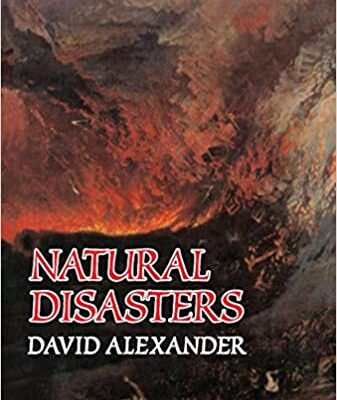
1st Edition
by David C. Alexander (Author)
As a well balanced and fully illustrated introductory text, this book provides a comprehensive overview of the physical, technological and social components of natural disaster. The main disaster-producing agents are reviewed systematically in terms of geophysical processes and effects, monitoring, mitigation and warning. The relationship between disasters and society is examined with respect to a wide variety of themes, including damage assessment and prevention, hazard mapping, emergency preparedness, the provision of shelter and the nature of reconstruction. Medical emergencies and the epidemiology of disasters are described, and refugee management and aid to the Third World are discussed. A chapter is devoted to the sociology, psychology, economics and history of disasters.; In many parts of the world the toll of death, injury, damage and deprivation caused by natural disasters is becoming increasingly serious. Major earthquakes, volcanic eruptions, droughts, floods and other similar catastrophes are often followed by large relief operations characterized by substantial involvement of the international community. The years 1990-2000 have therefore been designated by the United Nations as the International Decade for Natural Disaster Reduction.; The book goes beyond mere description and elevates the field of natural catastrophes to a serious academic level. The author's insights and perspectives are also informed by his practical experience of being a disaster victim and survivor, and hence the unique perspective of a participant observer. Only by surmounting the boundaries between disciplines can natural catastrophe be understood and mitigation efforts made effective. Thus, this book is perhaps the first completely interdisciplinary, fully comprehensive survey of natural hazards and disasters. It has a clear theoretical basis and it recognizes the importance of six fundamental approaches to the field, which it blends carefully in the text in order to avoid the p
1st ed. 2020 Edition
Hardcover – January 1, 1993
1st Edition
by Peter Winchester (Author)
Natural disasters make dramatic reading. Every year, some area of the world is devastated by a disaster, with enormous consequent loss of life and disruption to livelihoods. What can be done to alleviate this? Why are such disasters so lethal? Why do people expose themselves to such hazards? Do mitigation programmes help? What effect does aid really have on the areas that receive it? By examining one particular cyclone-prone area of Southern India in great detail over a 10-year period Peter Winchester has come up with some perceptive answers to the questions. In particular, he formulates a set of five 'golden rules' for disaster management. The book will provide valuable and thought-provoking reading for anyone involved with disaster management, and will be essential for all those whose work involves aid or development in disaster-prone areas.


There are no reviews yet.