
Product details
- Publisher : Island Press; Illustrated edition (May 16, 2003)
- Language : English
- Hardcover : 584 pages
- ISBN-10 : 1559636521
- ISBN-13 : 978-1559636520
- Item Weight : 1.97 pounds
- Dimensions : 6 x 1.4 x 9 inches
$63.00
Illustrated Edition
by Peter Friederici (Editor), Ecological Restoration Institute (Editor), Gary Paul Nabhan (Foreword)
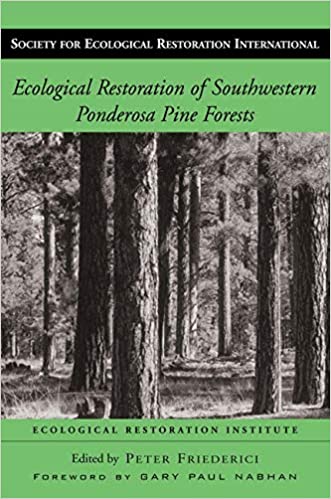
Ecological Restoration of Southwestern Ponderosa Pine Forests brings together practitioners and thinkers from a variety of fields-including forestry, biology, philosophy, ecology, political science, archaeology, botany, and geography-to synthesize what is known about ecological restoration in ponderosa pine forests and to consider the factors involved in developing and implementing a successful restoration effort. The book examines: the overall context for restoration-ecological, social, economic, political, and philosophical; how ecosystem processes such as fire, hydrology, and nutrient cycling are affected by restoration activities; treatment effects on specific ecosystem components such as trees, understory plants, animals, and rare or invasive species; the details of implementing restoration projects, including smoke management, the protection of cultural resources, and monitoring; Each section is introduced with a case study that demonstrates some of the promises and pitfalls of restoration projects. Ecological Restoration of Southwestern Ponderosa Pine Forests is the second book in the series The Science and Practice of Ecological Restoration from the Society for Ecological R
Shipping rates are calculated based on local US cities; international rates may apply for other countries.
Illustrated Edition
by David J. Gibson (Author)
Grasslands, in particular managed pastures and rangelands, are widespread, covering approximately 40% (52 million km²) of the Earth's land surface. They are dominated by members of the Poaceae - the fourth largest plant family with over 7,500 species, and also the most widespread. Grasslands constitute a major biome on all continents except Antarctica and also represent the most important food crop on Earth with corn, wheat, maize, rice and millet accounting for the majority of our agricultural output. Grasses and Grassland Ecology provides an ecologically orientated introduction to this influential group of plants, summarizing the most recent scientific research in ecology and agriculture in the context of the older, classic literature. Ten chapters cover the morphology, anatomy, physiology and systematics of grasses, their population, community and ecosystem ecology, their global distribution, and the effects of disturbance and grassland management. This comprehensive and accessible textbook is suitable for graduate level students as well as professional researchers in the fields of plant ecology, rangeland science, crop science, and agriculture.
0002- Edition
by James K Agee (Author)
It was once widely believed that landscapes become increasingly stable over time until eventually reaching a climax state of complete stability. In recent years, however, that idea has been challenged by a new understanding of the importance and inevitability of forces such as storms and fires that keep ecosystems in a state of constant change. The dynamics of fire ecology has emerged as a central feature of the new understanding as scientists and land managers redefine traditional assumptions about the growth and development of ecosystems. Fire Ecology of Pacific Northwest Forests is a historical, analytical, and ecological approach to the effects and use of fire in Pacific Northwest wildlands. James K. Agee, a leading expert in the emerging field of fire ecology, analyzes the ecological role of fire in the creation and maintenance of the natural forests common to most of the western United States. In addition to examining fire from an ecological perspective, he provides insight into its historical and cultural aspects, and also touches on some of the political issues that influence the use and control of fire in the United States. In addition to serving as a sourcebook for natural area managers interested in restoring or maintaining fire regimes in Pacific Northwest wildlands, this volume provides an essential base of knowledge for all others interested in wildland management who wish to understand the ecological effects of fire. Although the chapters on the ecology of specific forest zones focus on the Pacific Northwest, much of the book addresses issues not unique to that region
1st Edition
by Lee E. Frelich (Author)
Lee Frelich provides a major contribution to the study of temperate-zone forest dynamics by considering three important themes: the combined influence of wind, fire, and herbivory on the successional trajectories and structural characteristics of forests; the interaction of deciduous and evergreen tree species to form mosiacs; and the significance of temporal and spatial scale with regard to the overall impact of disturbances. These themes are explored via case studies from the forests in the Lake States of Minnesota, Wisconsin and Michigan, where the presence of large primary forest remnants provides a unique opportunity to study the long-term dynamics of near-boreal, pine, and hardwood-hemlock forests.
Paperback
1st Edition
(Tasks for Vegetation Science, 31) Softcover reprint of the original 1st ed. 1994 Edition
by Margarita Arianoutsou-Faraggitaki (Editor), R.H. Groves (Editor)
The Sixth International Conference on Mediterranean Climate ecosystems was held at Maleme (Crete), Greece, from September 23 to September 27, 1991. This conference had as its theme 'Plant-Animal Interactions in Mediterranean-type Ecosystems'. Most of the papers presented to that meeting have already been published (see Thanos, C.A. ed., 1992, Proceedings of the VI International Conference on Mediterranean Climate Ecosystems, Athens, 389 pp.). These 57 papers were all necessarily short. But the theme of plant-animal interactions was considered by the Organizing Committee to be so important to a fundamental understanding of the ecology of Mediterranean-climate ecosystems and to an enhanced management ·of those systems that various international research scientists were invited to prepare longer contributions on major aspects of the overall theme. The Book that follows represents the result of those invitations. All five regions of Mediterranean climate are represented - Chile, California, southern Australia and the Cape Province of South Africa, as well as the Mediterranean Basin itself.

There are no reviews yet.